

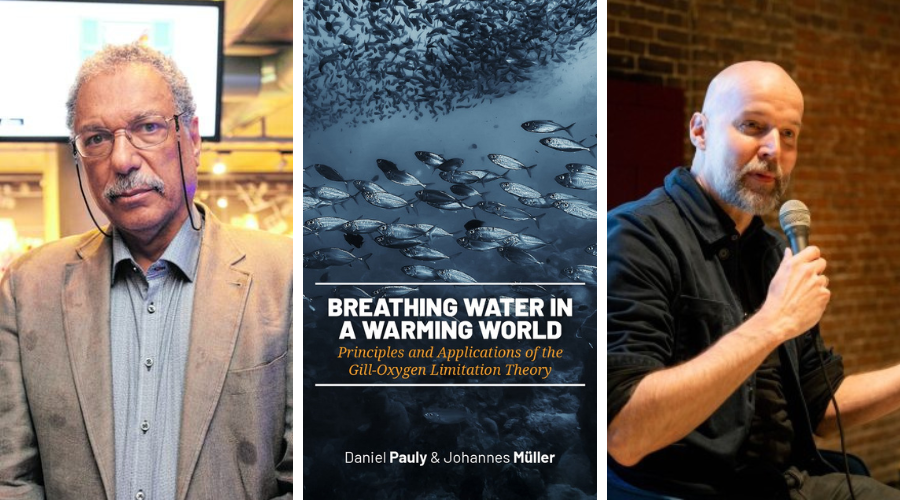
Daniel Pauly (left) and Johannes Müller (right).
In a world where the dramatic effects of global warming on land dominate news headlines, there is a tendency to overlook the massive impacts of warming and deoxygenation on oceans and freshwater ecosystems. However, the effects of climate change on the species that inhabit these ecosystems are, in some respects, more drastic than the challenges faced by terrestrial animals.
For water-breathers like fish and squids, warmer, less oxygenated waters mean they require more oxygen to maintain their metabolic processes, and their oxygen demand often reaches levels that exhaust their uptake capacities. In other words, they end up short of breath – a physiological state humans experience only when we attempt to run a marathon, or ascend Mount Everest without supplementary oxygen.
In Breathing Water in a Warming World (Sidestone Press), Daniel Pauly, principal investigator of the Sea Around Us initiative at the University of British Columbia, and Johannes Müller, assistant professor at the Leiden University Centre for the Arts in Society, not only explain the effects of climate warming on water-breathing animals, but they also explore the theoretical foundation that allows for a more comprehensive understanding of the eco-physiological processes that shape underwater life.
That theoretical foundation is the Gill-Oxygen Limitation Theory (GOLT), which was developed 45 years ago in Pauly’s doctoral thesis. Its basic tenet is that water-breathing animals deal with the limited availability of oxygen in water through several adaptations. Chief among these adaptations are halting growth, timing maturation, and migrating based on how much oxygen their three-dimensional bodies are able to get through their two-dimensional gills.
The book explores the physics and physiology behind the GOLT and introduces it as the overarching principle that explains such physiological mechanisms and constraints, and provides a foundation for more effective responses to the current crisis in our planet’s oceans, lakes, and rivers.
“As the best scientists do, Drs. Pauly and Müller also entertain criticisms of the GOLT and consider alternative hypotheses for its predictions,” Dr. Mark J. Butler IV, eminent scholar and professor at Florida International University’s Institute of Environment Department of Biological Sciences, writes in the foreword. “Indeed, the GOLT has spawned a flurry of research by teams from around the world, including my own. We are putting this provocative theory to the ‘acid test.’ It is that important.”
Breathing Water in a Warming World: Principles and Applications of the Gill-Oxygen Limitation Theory is available in paperback and hardback, as well as a free-to-download digital version on the Sidestone Press website.