

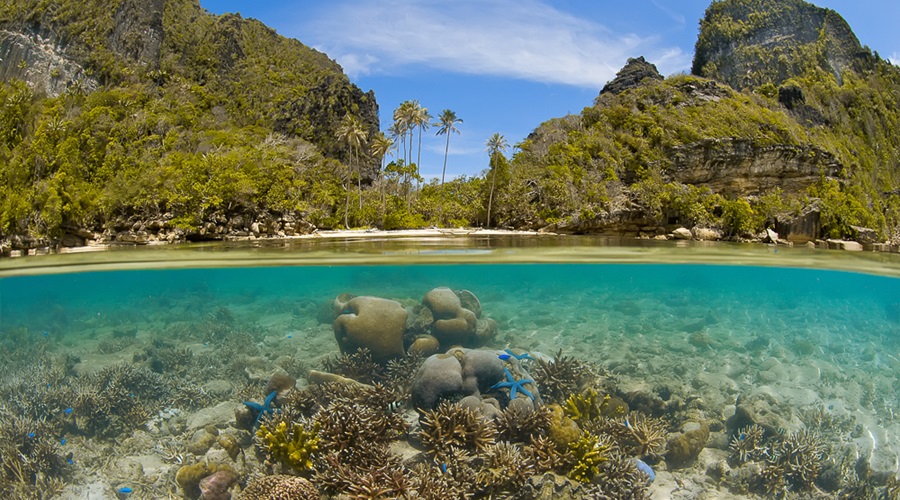
Coral reef in Raja Ampat. Photo by Bird’s Head Seascape / Jones/Shimlock / Secret Sea Visions, Wikimedia Commons.
World Oceans Day (WOD), the initiative proposed in 1992 by Canada at the Earth Summit in Rio de Janeiro and officially recognized by the UN in 2008, aims to catalyze collective action for a healthy ocean and a stable climate.
Some of the yearly campaigns thousands of organizations run, inspired by this goal, are guided by the annual action theme that NGO The Ocean Project proposes for WOD. The Ocean Project, together with the World Ocean Network, led efforts to get the UN to recognize June 8th as World Oceans Day.
For 2026, the action theme is “Strong Marine Protected Areas for our blue planet,” which is meant to build on the momentum of recent agreements, such as the 2022 Kunming-Montreal Global Biodiversity Framework and the High Seas Treaty ratified in 2025, and push for stronger ocean conservation actions.
To support this endeavour, every month from January to June 2026, the Sea Around Us will take a deep dive into one MPA in its database and use this blogging space to share, in lay language, what factors make it a successful or unsuccessful MPA.
Misool Marine Reserve
The Misool Marine Reserve is located in Raja Ampat, an archipelago that belongs to Indonesia’s Southwest Papua province, which, in turn, is part of the Coral Triangle.
It was established in 2005 as a no-take zone through a partnership between local communities and a private company (the Misool Resort), with the support of the Raja Ampat Marine Park Authority. The goal was to put a halt to ongoing shark finning and unregulated fishing operations that were destroying the area’s reef ecosystem.
Since then, the reserve has expanded and now encompasses an area of 1,220 square kilometres, including a second no-take-zone and a linking restricted-gear blue water corridor, all of which are leased directly from the local villages.
The lease area includes the sea and reefs, as well as the islands Kalig, Yillet, Boo, Fiabacet, Batbitim, Kanim, Sapenipnu, Jef Gelu, and Warakaraket.
Inside the two no-take zones, all extractive practices are prohibited. No fishing, no collecting turtle eggs, no reef bombing, no cyanide fishing, no netting, and no shark finning is allowed.
Outside the no-take zones, however, light to moderate fishing was reported to the Sea Around Us. Our research found that fishing is done mostly by locals who target groupers and other reef fish using handlines. Other fishers target anchovies using ‘bagan,’ a traditional Indonesian lift net held by a wooden structure and left in the water for specific periods.
According to the Misool Foundation, which now administers the park, highly coveted species are sometimes targeted by illegal fishers, with patrols intercepting an average of 60 unregulated boats per year.
Overall, the reserve is monitored 24/7 by an 18-person unit of local rangers who move between three stations using five dedicated patrol boats.
The Foundation notes that its scientific surveys show that, despite the odd cases, enforcement has been effective as fish biomass has increased by about 250 per cent between 2007 and 2021, with fishers working outside the Misool Marine Reserve reporting better catches.
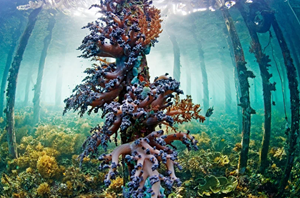
Underwater beauty in Raja Ampat, Indonesia. Photo by USAID, Rawpixel.
Baited Remote Underwater Video Surveys (BRUVS), on the other hand, have shown that shark numbers inside the Misool Marine Reserve have increased by 190 per cent since 2012, while the sub-population of mantas has doubled over 10 years, now reaching 1730 individuals.
In terms of biodiversity, the area also hosts bamboo shark, Nursalim’s flasher wrasse, Jamal’s dottyback, bird’s head jawfish, and Misool cardinalfish. Some of these fish have found refuges and nursery grounds in Misool’s mangrove forests.
Although efforts to preserve such biodiversity have yielded positive results, other challenges remain. Seawater temperature keeps increasing and, with it, so does the number of corals undergoing bleaching.
“What once hovered around 27-28 °C, now consistently spikes to 29-32 °C,” Murid Saleo, the Foundation’s lead reef restoration specialist, told Oceanographic magazine.
Waste management is another concern, as large-scale removal is not viable. This means that many times garbage is burnt or cast straight into the ocean. Although locals lead solid waste management efforts, challenges in this regard remain.
“Misool is a good example of what can be accomplished when different groups, such as the local community, authorities and tourism operators, join forces to protect the ocean,” the Sea Around Us PI, Dr. Daniel Pauly, said. “One would only hope that other actors accessing the reserve learn about the value of not only respecting the no-take zones, but also refraining from littering both the land and sea.”