

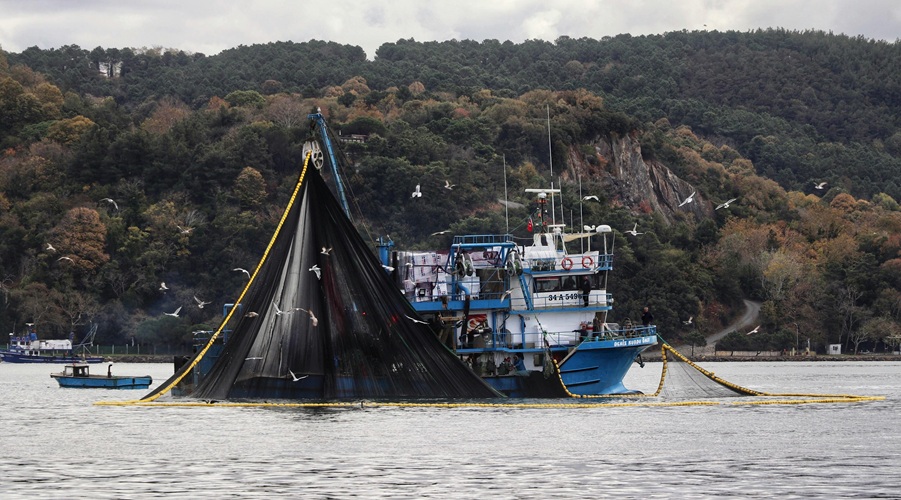
Purse seine. Photo by Hüseyin Ergül, Pexels.
The global fishing industry should be appropriately represented within climate change mitigation frameworks, where it remains overlooked, a new letter published in Science suggests.
Co-authored by the Sea Around Us associated faculty, Dr. William Cheung, principal investigator of the Changing Ocean Research Unit at UBC’s Institute for the Oceans and Fisheries (IOF), Dr. Rashid Sumaila, principal investigator of the IOF’s Fisheries Economics Research Unit, and the Sea Around Us principal investigator, Dr. Daniel Pauly, the letter argues that properly assessing emissions caused by fishing fleets and, therefore, offering potential mitigation strategies, would only enrich global decarbonization models, such as that which proposes “stabilization wedges,” presented by N. Johnson and I. Staffell in a paper in the same May 21 edition of the journal.
Stabilization wedges are identified as scalable strategies to reduce greenhouse gas emissions. “Marine wild fisheries can also serve as a climate mitigation wedge,” Cheung, Sumaila and Pauly write.
Emissions from both fuel use and the release of carbon stored in seafloor sediments by bottom trawling add up to about 0.5 Gt of carbon dioxide per year, which is 0.23 Gt of CO2 more than those produced by the direct emissions from the smelting, refining, and anode production of the global aluminum industry.
“Transforming the fishing sector would deliver benefits beyond climate mitigation,” the UBC authors state, while highlighting how such a transformation would also boost biodiversity conservation and sustainable food production. Thus —they say—recognizing ocean sectors within mitigation frameworks, such as the wedge approach, has the potential to enable more well-rounded strategies.
To read the full letter, visit 10.1126/science.aeh0199