

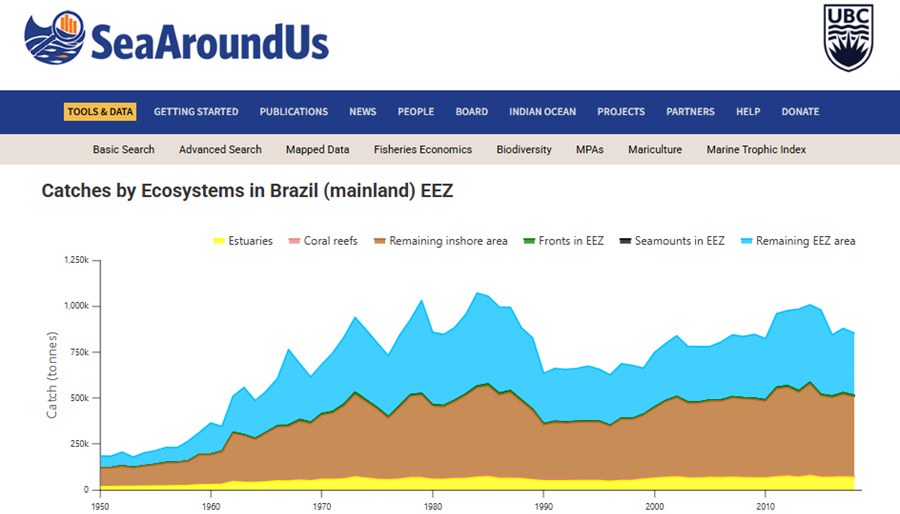
When users explore reconstructed catches by Exclusive Economic Zone (EEZ) on the Sea Around Us website, they can also view how those catches are distributed across key ecosystems.
By scrolling down on a EEZ page and selecting “Ecosystems” on the “More info” section, users can access total catches by Inshore Fishing Area (IFA), estuaries, coral reefs, and seamounts. This ecosystem lens adds critical context, revealing not just how much is caught within an EEZ, but where those catches originate ecologically—and what that means for management.
Inshore Fishing Area:
This is the area extending from shore to either 50 km offshore or to the 200 m depth contour, whichever comes first. This area parameter is meant to establish a distinction between large-scale (industrial) and small-scale (artisanal, subsistence, and recreational) fisheries. While industrial fleets can operate throughout and beyond EEZ waters, small-scale fisheries are defined as operating in nearshore coastal waters. Thus, IFAs are only assigned to inhabited territories with local fisheries.
Estuaries:
These are the areas where rivers meet the sea. They are dynamic systems shaped by gradients in salinity, temperature, nutrients, and turbidity. Although species diversity may be lower than in adjacent marine ecosystems, productivity can be very high for species adapted to these conditions. Estuaries are essential for amphidromous, anadromous (e.g., sturgeons, salmons), and catadromous species (e.g., eels), and they often support important seasonal fisheries.
To account for their significance, the Sea Around Us developed the first global estuary database with digitized spatial boundaries. Currently, over 1,200 estuaries in more than 120 countries and territories are included, representing more than 80 per cent of the global freshwater discharge.
Coral reefs:
Reef-building corals are formed of colonies of coral polyps held together by calcium carbonate. They exist both in temperate and tropical waters, but shallow-water reefs form only in a zone extending from approximately 30° N to 30° S of the equator.
Tropical coral reefs are among the most diverse ecosystems on Earth, typically occurring in shallow waters down to about 30 metres.
Because global estimates of coral reef area vary widely depending on definitions and mapping scales, the Sea Around Us reports the percentage of the world’s coral reef area occurring within each EEZ, based on maps from the UNEP World Conservation Monitoring Centre interfaced with EEZ boundaries.
Seamounts:
These are underwater mountains, usually of volcanic origin, rising at least 1,000 metres from the seafloor. They are identified through a global analysis of bathymetric data.
Given that only a small fraction of seamounts has been mapped directly, our database provides a conservative global estimate of their distribution.
Fronts:
Within an Exclusive Economic Zone, fronts are dynamic boundary areas where water masses with different temperatures, densities, or salinity meet. These, often called oceanographic, ecological or physical fronts, act as hotspots for marine life, driving high productivity and aggregating commercial fish species