

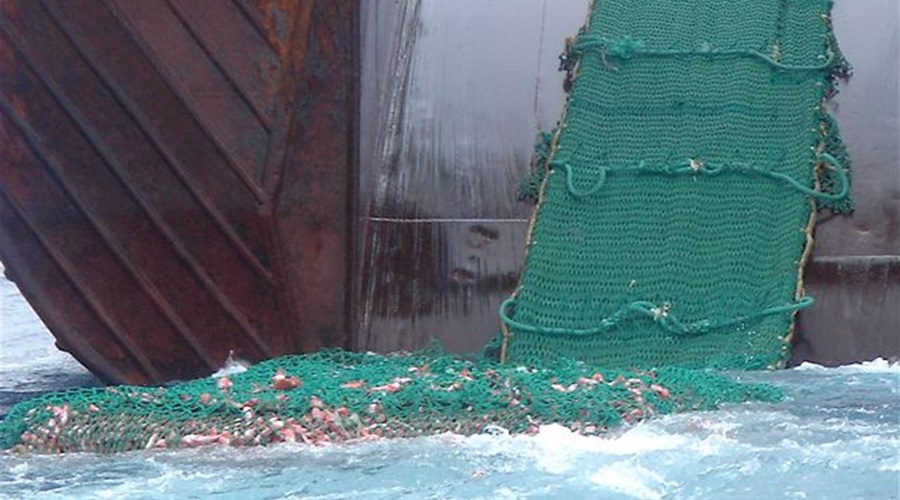
Bottom trawler. Photo by Lisa, Flickr.
A new study suggests the hidden climate costs of bottom trawling in European waters may far outweigh its economic benefits, raising questions about the future of one of the world’s most widespread fishing practices.
An international team of researchers found that bottom trawling in Europe generates an estimated net societal cost of between €2 billion and €16 billion annually, driven largely by the release of carbon stored in seafloor sediments.
The paper, published in the journal Ocean & Coastal Management, analyzed the economic benefits vis-à-vis the environmental costs of commercial bottom trawl and dredge fisheries across European waters between 2016 and 2021.
Bottom trawling involves dragging heavy nets across the ocean floor to catch fish and shellfish species. While the industry provides food and employment, the researchers found the broader public bears substantial costs linked to carbon emissions, habitat destruction, discarded catch and subsidies.
“Our findings suggest society may be losing out while the private sector captures most of the benefits,” said lead author Katherine D. Millage, a marine scientist with Pristine Seas. “The highest quantified cost comes from disturbing carbon-rich seabed sediments, which can release significant amounts of CO2 into the atmosphere. Even under conservative assumptions, those climate-related costs are enormous.”
The researchers estimated that carbon emissions associated with disturbed seafloor sediments alone could cost society between €4.9 billion and €18.1 billion per year. By comparison, the largest quantified public benefit—the value of protein supplied for human consumption—was estimated at €2.46 billion annually.
The study also found that nearly one-quarter of Europe’s bottom trawling activity, measured by hours spent fishing, occurred within marine protected areas (MPAs).
“This overlap raises important questions about what protection really means,” said Dr. Maria ‘Deng’ Palomares, paper co-author and manager of the Sea Around Us initiative at the University of British Columbia’s Institute for the Oceans and Fisheries. “Many MPAs still allow destructive fishing practices that can damage sensitive habitats and undermine conservation goals. Reducing bottom trawling in these areas could provide meaningful benefits for biodiversity and climate.”
The authors emphasize that they are not calling for an immediate shutdown of the industry, but rather for a careful reassessment of fisheries policies and subsidies, leading to a reduction in bottom trawling effort.
At present, Europe provides roughly €1.17 billion annually in subsidies supporting bottom trawling, which is comparable to the sector’s direct employment value. Redirecting those funds toward vessel buybacks, retraining programs and lower-impact fishing methods could help support fishing communities through a transition.
Only about two per cent of Europe’s animal protein is supplied by bottom trawling fisheries, which suggests that food security impacts from reducing the practice may be limited, particularly when accounting for discarded —normally edible— fish, whose lost value for the region was estimated at €220 million.
“Trade-offs between food production, employment and conservation are real,” said Millage. “But our results show there may be pathways to reduce bottom trawling effort while generating greater long-term benefits for society overall.”
The researchers caution that uncertainties remain around exactly how much carbon is released from disturbed sediments, but argue the potential scale of the impacts warrants precautionary action.
“With Europe aiming to reach net-zero emissions and halt biodiversity loss, fisheries policy has an important role to play,” Dr. Palomares said. “This study shows that protecting marine ecosystems and addressing climate change go hand in hand.”
Te paper “Bottom trawling in Europe may cost society billions, study finds” was published in Ocean & Coastal Management, https://doi.org/10.1016/j.ocecoaman.2026.108135