

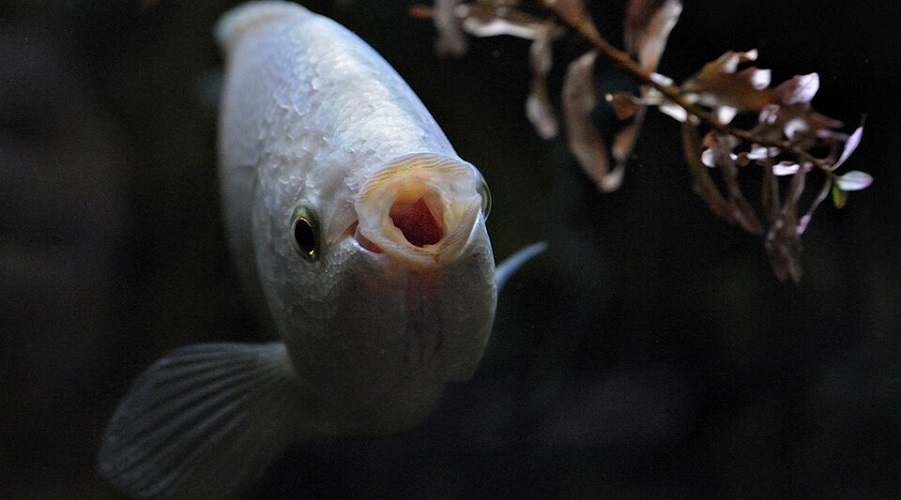
Helostoma temminckii or kissing gourami. Image by Jörn, Wikimedia Commons.
A new essay published in Issues in Science and Technology argues that current animal welfare science and policy frameworks overlook a fundamental aspect of the lives of fish and other aquatic “water-breathing” species — and calls for a shift in how governments, researchers, and industry assess humane treatment in aquaculture, research, commercial fisheries, and in the wild.
The essay — authored by Dr. Jennifer Jacquet, a professor in the Department of Environmental Science and Policy at the University of Miami Rosenstiel School of Marine, Atmospheric, and Earth Science, and Dr. Daniel Pauly, principal investigator of the Sea Around Us initiative at the University of British Columbia’s Institute for the Oceans and Fisheries — contends that longstanding animal-welfare models were built around mammals and birds and fail to account for the central biological reality of aquatic life: access to oxygen.
Jacquet and Pauly maintain that the influential “five freedoms” framework guiding global welfare standards was conceived by and for air-breathing animals and therefore omits a critical dimension for fish and other aquatic organisms — the ability to breathe safely in water. They point out that air exposure, crowding, warming waters, and declining dissolved oxygen levels can cause severe physiological stress and pain in these species, particularly in industrial fishing and aquaculture settings.
“Water-breathers without water to irrigate their gills are suffocating,” the authors write, noting that experiments and field studies demonstrate that even brief periods of air exposure can be associated with acute distress and elevated mortality in fish. The essay highlights emerging research showing behavioural and neurophysiological indicators of intense pain during air asphyxiation — the most common method of fish slaughter worldwide — and warns that some proposed alternatives may produce even greater suffering if not carefully evaluated.
Read the full announcement here.