

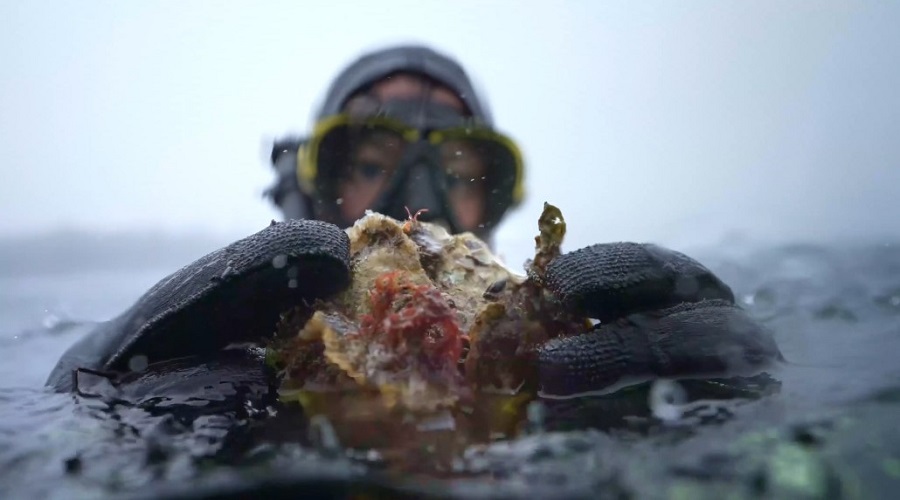
Image from City of Shells by Mike Sakas.
Pearls, aphrodisiac concoctions, and Asian sauces. When we, ‘moderns,’ think about oysters, we rarely connect them to the substrate of a city.
Hong Kong and its Pearl River Delta area, as it turns out, have been built both structurally and socio-culturally atop what used to be extensive oyster reefs. However, these ecosystems have been decimated by dredging for lime and mega-city development.
Historical documents trace back lime production from oyster shells over 1000 years, but it was in the 19th and early 20th centuries when the industry peaked in the former British colony, where the mineral was used to produce paper and building materials, and as a fertilizer. Mountains of shellfish were scooped out of the reef, their meat extracted to produce sauce, and their shells burnt by the tonne in kilns spread out across Hong Kong’s coastline.
What was once thought of as an infinite resource eventually disappeared, making the island’s shellfish habitat one of the many that are endangered worldwide.
A recently released documentary, City of Shells: Our Forgotten Oyster Reefs, follows the traces of incinerated oyster shells back to the delta and the sea, in a quest to reconstruct Hong Kong’s original shellfish reef abundance.
“Historical marine ecology, the discipline that emerged partly because of the 1995 paper on shifting baselines, establishes that the biodiversity in the sea was much greater than we can even imagine now,” Dr. Daniel Pauly, the Sea Around Us Principal Investigator, says in the film. “Shifting baselines makes us forget that we have lost something.”
To illustrate this concept, Dr. Pauly presents the example of a 25-year-old fisher who may think the tuna stocks he fishes are massive. However, the evidence shows that if he has only been fishing for 10 years, he is most likely experiencing fish populations that are 5 per cent of what they used to be 100 years ago.
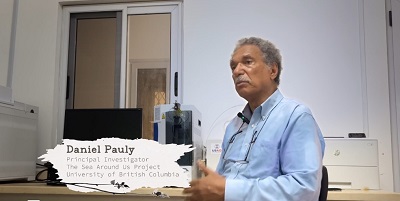
The Sea Around Us PI, Dr. Daniel Pauly, in City of Shells. Image by Mike Sakas.
“If we want to assess changes in the natural world, we need to anchor them in the past beyond one or two generations,” he points out.
With this sort of mantra in mind, the star of the film, restoration ecologist Marine Thomas, together with her team of researchers and citizen scientists from The Nature Conservancy, The University of Hong Kong and The Explorer’s Club, is shown conducting historical research, ecological surveys and dive expeditions as they search for remnant reefs to piece together clues about where these lost habitats might still perdure.
Their findings suggest that not all is lost. They believe that if restoration efforts -basically, ‘planting’ oysters and letting them be – are implemented at scale, the reefs could flourish once more.
In fact, one of their main projects is retrofitting the Hong Kong airport’s third runway seawall using recycled construction material, as it is known that shellfish used to flourish in the area. According to the researchers, the prospect is huge – by filtering millions of litres of water daily, providing essential habitats for countless marine species, and acting as natural coastal barriers against storms and erosion, the restored ecosystems would significantly enhance Hong Kong’s biodiversity and ocean health.
City of Shells: Our Forgotten Oyster Reefs can be accessed on this page.