
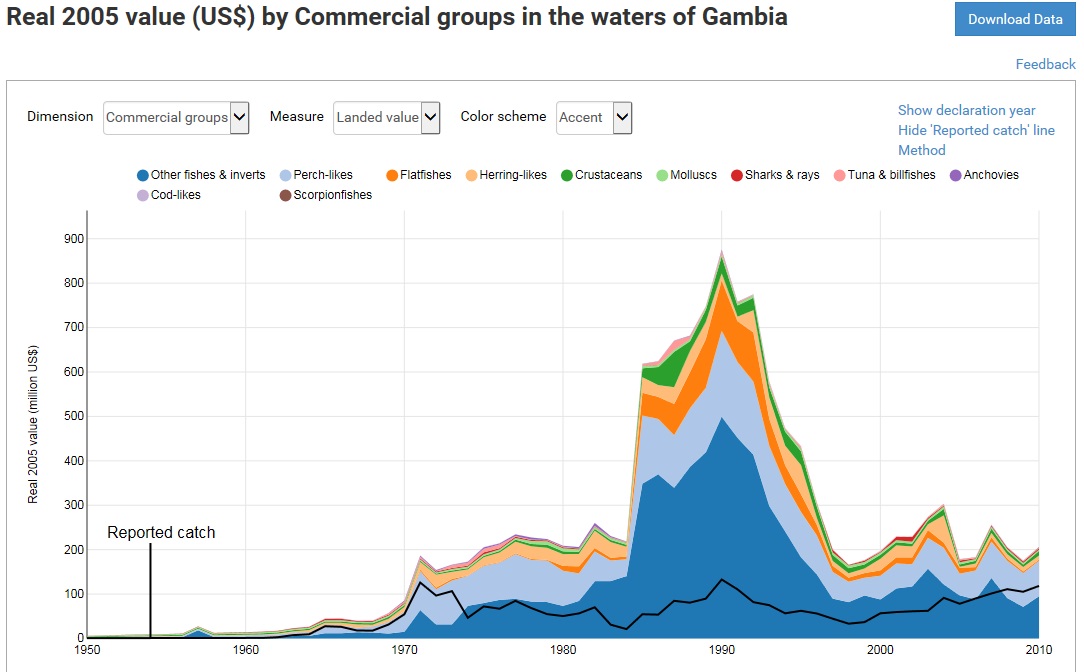
The landed value of commercial fish in the waters of the Gambia, 2005
If and how well a fishery is managed often depends largely on the economics of that fishery, and central to understanding the economics of a fishery are the availability of data.
The Sea Around Us, in collaboration with the Fisheries Economics Research Unit (FERU), has over the years built extensive datasets of economic information – like ex-vessel prices and subsidies data – which are being made available to policy makers and the public.
Many of the existing price databases today are either incomplete or unavailable to the public. Using the reconstructed catch data from the Sea Around Us, and the economic datasets assembled by FERU, the information we have is well-organized and easy to access.
Further, while the United Nations Food and Agriculture Organization (FAO) publishes processed and product fish prices, they do not present ex-vessel price, i.e., the price at first point of sale a fisher realizes upon sale of their catch. The Sea Around Us does include this price, thus allowing emphasis of the economic value on the core actors of the industry – the fisher.
Therefore, the landed values data the Sea Around Us presents via our website expresses the ex-vessel value (in US$) of the catch to the fisher (i.e., catch multiplied by ex-vessel price), and excludes added value through the economic value chain.
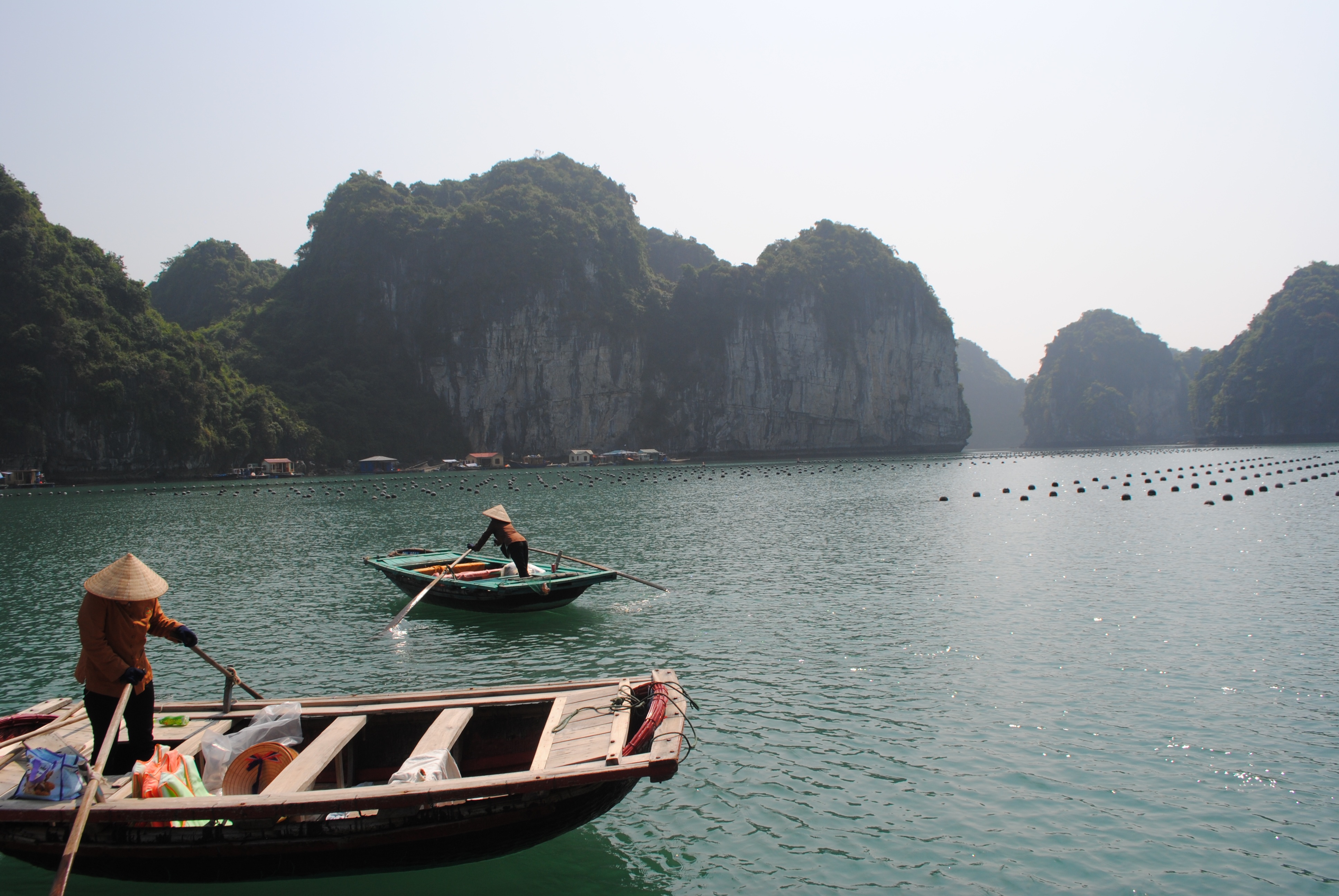
Fishers in Ha Long Bay, Vietnam. (Credit: Rafa Prada)
In partnership with FERU, work is ongoing to build and incorporate other economic datasets into the global database of the Sea Around Us.
As Dr. Rashid Sumaila, the Director of FERU writes: “To be able to devise management policies that appropriately take account of fisher behavior and thereby ensure the sustainability of fisheries resources, managers need to have a good knowledge of ex-vessel prices for the species under their management” (Sumaila et al., 2007).
Using our separate fisheries economics tool (bit.ly/1Z4ybDd), researchers and other interested users can find the time series (1950 to currently 2010) of landed values for the various different taxa in the catches from EEZ’s and LME’s. And, by having landed values, Sumaila writes, researchers can better determine the “local, regional and global economic and social impacts of different management policies.”
But the Sea Around Us and FERU also provide another core economic dataset: Data on fisheries subsidies.
While some subsidies can be beneficial to fisheries; Sumaila found, in another paper, that the “amount of subsidies provided by governments of the world to their fishing sector is quite large and that most of these subsidies lead to overcapacity and overfishing.”
With our fisheries economics tool, researchers can examine the amount of money that countries spend on fisheries subsidies, broken down into categories like fisheries services, research and development, tax exemptions and fuel subsidies, among many others.
And more importantly, we also determine whether the subsidies that are used are ‘beneficial,’ ‘harmful,’ or ‘ambiguous,’ the latter meaning it is not always straight forward to determine the effects of the subsidy.
This information is all directly and easily accessible for researchers, NGO’s and governments to use.
References:
Sumaila, U. R., Marsden, A. D., Watson, R., & Pauly, D. (2007). A global ex-vessel fish price database: Construction and applications. Journal of Bioeconomics 9(1), 39–51.
Sumaila, U.R., Khan, A., Duck, A., Watson, R., Munro, G., Tyedmers, P. & Pauly, D. (2010). A bottom up re-estimation of global fisheries subsidies. Journal of Bioeconomics 12:201–225.