
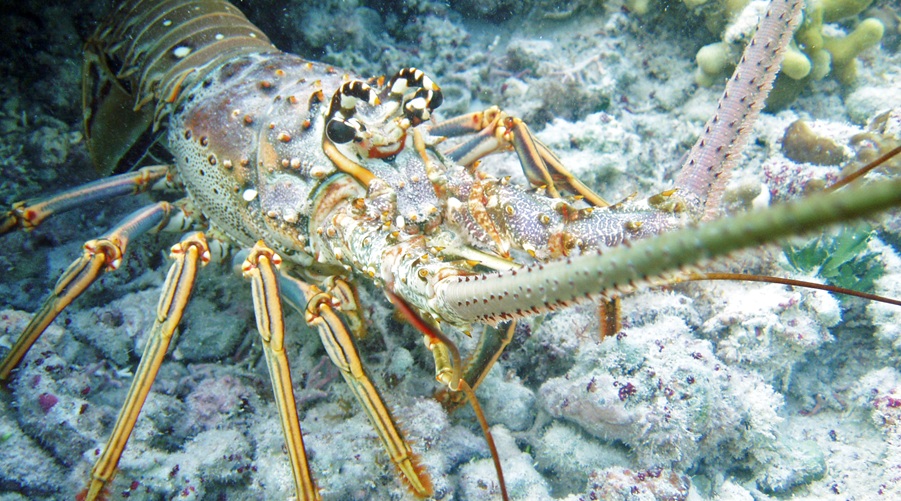
Caribbean spiny lobster. Photo by James St. John, Wikimedia Commons.
Most of The Bahamas’ signature seafood stocks are being fished harder than the sea can replace them, a new paper led by Sea Around Us researchers and published in Frontiers in Marine Science shows.
These findings are the result of the assessment of 12 of the most commercially and culturally important marine species in the country and draw on reconstructed catch records spanning 73 years (1950 to 2022). They confirm what Bahamian fishers have been saying for a generation: most signature seafood stocks are disappearing from the country’s waters.
Of the dozen species evaluated, 11 are overfished to some degree. Nassau grouper and yellowfin grouper are classified as “grossly overfished.” Queen conch, Caribbean spiny lobster, hogfish, black grouper, rock hind and wahoo are “overfished.” Lane snapper, mutton snapper and gray snapper are “slightly overfished.” Only the dolphinfish, the mahi mahi of beach-hotel menus and offshore recreational trips, is classified as healthy.
To estimate how much biomass —the weight of the population in the water— remains for each of the species, the researchers applied CMSY++, a stock assessment method developed for data-poor fisheries, which they fed with combined reconstructed catches using national landings data provided by the Department of Marine Resources (DMR), long-term PIMS and AGRRA survey data, regional stock assessments from the Gulf of Mexico and southeastern Florida, and IUCN Red List.
“CMSY++ is designed for exactly this situation, a data-limited fishery where the decades of age-sampling and fishery-independent surveys needed for a full traditional assessment are not available, but reconstructed catches and careful priors are,” said Dr. Maria Lourdes ‘Deng’ Palomares, lead author of the paper and manager of the Sea Around Us initiative at the University of British Columbia’s Institute for the Oceans and Fisheries. “What this work does is stop The Bahamas from flying blind on 12 of its most commercially important species at once. It is a starting point that the previous decade of good intentions and partial surveys could not provide on its own.”
THE BIGGER PICTURE IN NUMBERS
The 73-year reconstruction estimates that The Bahamas has taken roughly 1.3 million tonnes of seafood out of its waters between 1950 and 2022, at an annual average of around 17,500 tonnes. Strikingly, the recreational sector (tourism-driven charter boats, sportfishing, and visiting anglers) is responsible for 46 per cent of the total reconstructed catch over that period. The industrial sector, dominated by the export-oriented spiny lobster fishery, accounts for 26 per cent, artisanal fishers for 23 per cent, and subsistence fishing for 5 per cent.
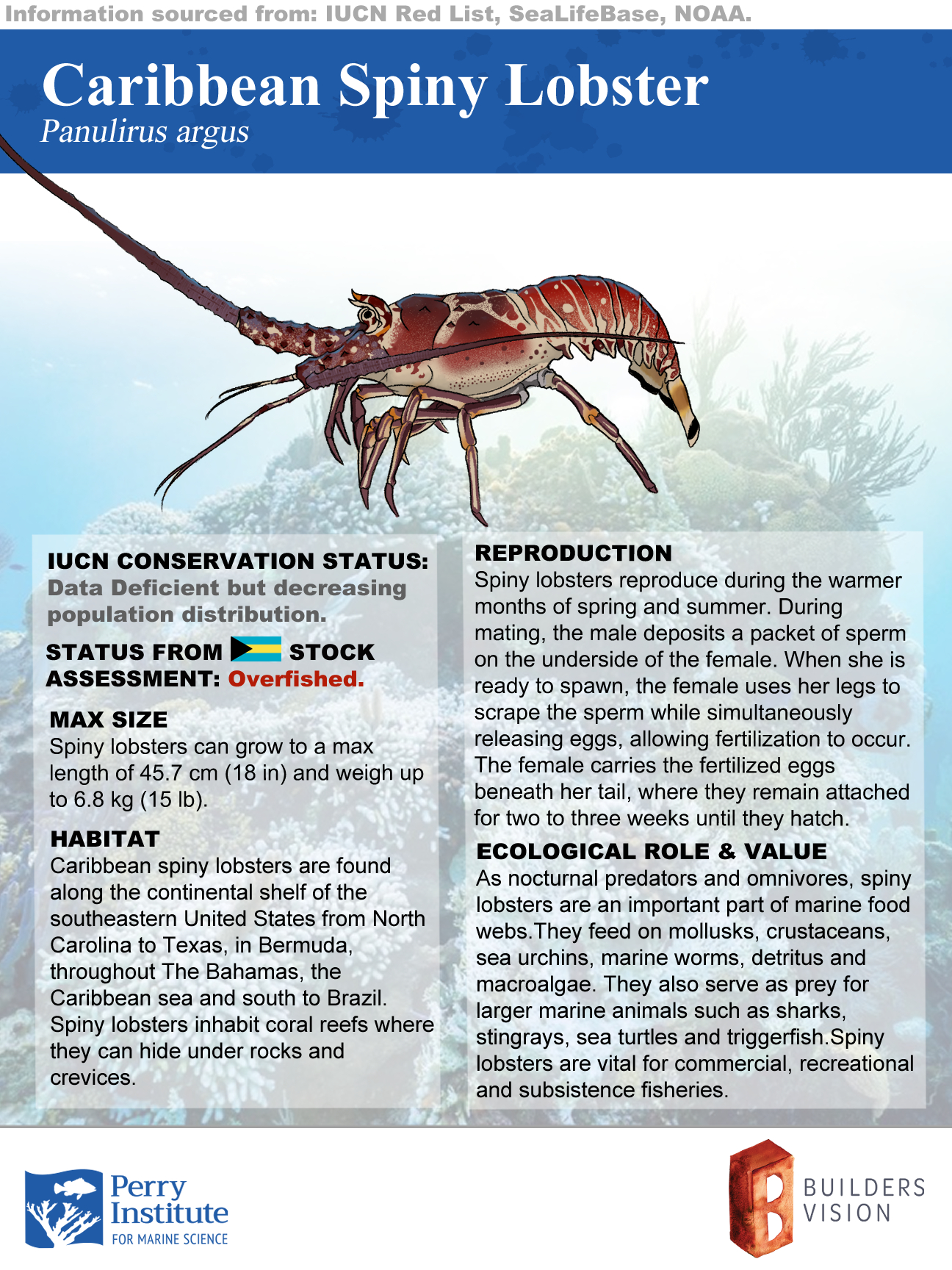
Caribbean spiny lobster alone is 33 per cent of the country’s total reconstructed catch, roughly 425,000 tonnes over the time series. Queen conch is another 21 per cent. Together, these two invertebrates represent more than half the seafood The Bahamas has extracted from its waters over the past seven decades. Both are now classified as overfished: spiny lobster at 61 per cent of the biomass that would support maximum sustainable yield, which is the theoretical highest catch that a fish stock can sustain in the long-term, given that environmental conditions do not change much. Queen conch, on the other hand, is at 59 per cent.
The reef groupers and snappers tell the hardest story. Yellowfin grouper is at just 40 per cent of the biomass that would support a sustainable harvest, the worst-off species in the paper. Nassau grouper, IUCN-listed as Critically Endangered since 2015, sits at 49 per cent. Catches of Nassau grouper remained above the maximum sustainable yield for nearly 40 years before collapsing from their mid-1990s peak, and have shown no sign of recovery since.
“These species are the backbone of The Bahamas’ domestic seafood supply, supporting commercial and subsistence fishers across the islands and anchoring local food security. Their overfished status means fewer fish in local markets and on local plates unless management action is taken,” said Dr. Krista Sherman, co-author of the study and a researcher at the Perry Institute for Marine Science (PIMS). “These assessments not only improve our understanding of the status of key fisheries but also provide a critical foundation for the sustainable management of these valuable resources moving forward.”
Among the large pelagic species, wahoo is overfished (at 78 per cent of the healthy reference), and dolphinfish is healthy (at 101 per cent). The paper cautions that both are shared stocks in the Western Central Atlantic, and neither has a conclusive population-level assessment for Bahamian waters alone.
“The pattern we see in The Bahamas, a handful of species still productive, most severely depleted, and a gap between what managers can observe and what they can act on, is characteristic of reef fisheries across the tropics,” said Dr. Daniel Pauly, principal investigator of the Sea Around Us, which has reconstructed the catch histories of more than 270 countries and territories since Pauly founded it in 1999. “What makes a difference in this case is the willingness of the Bahamian scientists, led by Dr. Sherman and Dr. Craig Dahlgren at the Perry Institute, to use a rigorous, globally comparable assessment rather than wait for ideal data that may never come. The results should concern anyone who eats Bahamian seafood, and they should motivate the management reforms the country’s own scientists have been advocating for.”
Alongside the paper, PIMS is releasing a set of plain-language species fact sheets for each of the twelve assessed species plus additional culturally important reef species, produced by Bahamian scientific illustrator Andrew Knowles. Each sheet translates the paper’s findings into guidance on identification, biology, fishing method, stock status and sustainability, designed for vendors, restaurants, cooks, anglers and consumers.