

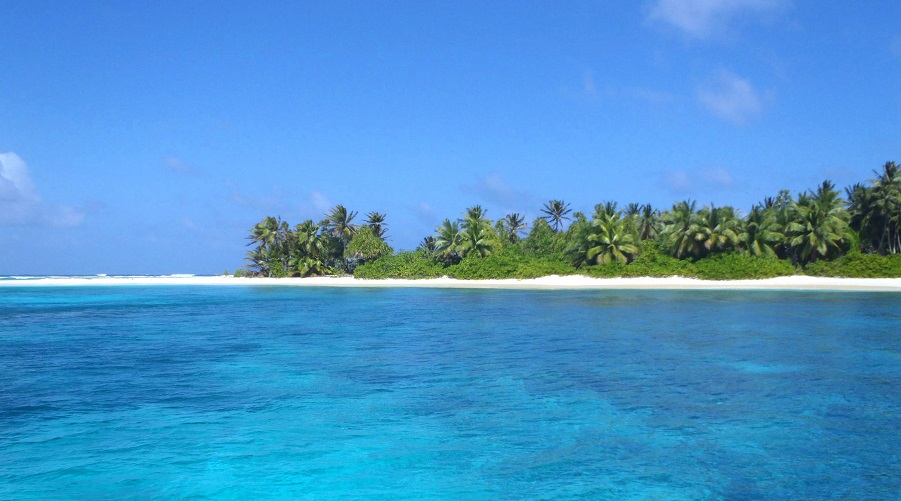
Clear blue water in the shallows of an island in the Marshall Islands. Photo by Erin Magee/AusAID, Wikimedia Commons.
World Oceans Day (WOD), the initiative proposed in 1992 by Canada at the Earth Summit in Rio de Janeiro and officially recognized by the UN in 2008, aims to catalyze collective action for a healthy ocean and a stable climate.
Some of the yearly campaigns thousands of organizations run, inspired by this goal, are guided by the annual action theme that NGO The Ocean Project proposes for WOD. The Ocean Project, together with the World Ocean Network, led efforts to get the UN to recognize June 8th as World Oceans Day.
For 2026, the action theme is “Strong Marine Protected Areas for our blue planet,” which is meant to build on the momentum of recent agreements, such as the 2022 Kunming-Montreal Global Biodiversity Framework and the High Seas Treaty ratified in 2025, and push for stronger ocean conservation actions.
To support this endeavour, every month from January to June 2026, the Sea Around Us will take a deep dive into one MPA in its database and use this blogging space to share, in lay language, what factors make it a successful or unsuccessful MPA.
Ailinginae Atoll
In June, we are exploring the 1,027-square-kilometre Ailinginae Atoll, which is a pristine, uninhabited coral atoll north of the Marshall Islands’ Ralik Chain, in the Western Pacific.
Ailinginae consists of 25 islets and was designated as a conservation management area and traditional reserve in 2002. It is also the country’s first national park.
The atoll has never been permanently occupied due to its remoteness, dry weather and because it was used by people living nearby on the Rongelap Atoll as a pantry reserve for periodic fishing.
Beginning in 2002, the Rongelap Local Government established several ordinances to protect Ailinginae, including bans on commercial fishing, limits on recreational fishing, and areas closed to fishing altogether, including the harvesting of birds and coconut crabs. Additional measures granted complete protection to rare and depleted species, and set up controls on camping and bans on littering and the use of plastics.
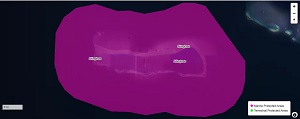
Satellite image of the Ailinginae Atoll. The purple colour indicates the Marine Protected Area. Photo by UNEP-WCMC and IUCN,
Protected Planet: The World Database on Protected Areas (WDPA), from Pacific Islands Protected Area Portal.
The reserve has a management plan that outlines its uses, which are mostly limited to research and boat-based tourism, all requiring a permit. Fishing for immediate consumption by tourists is allowed using hook and line, throw-nets (only on sandy areas, not near coral), and offshore trolling well beyond the reef for pelagic fish.
“Around the atoll, it is safe to say that ‘not much fishing’ happens. There is no enforcement; it is protected by remoteness and being uninhabited,” an academic source, here cited anonymously due to confidentiality and ethical guidelines, told the Sea Around Us.
The waters around Ailinginae are filled with large schools of skipjack and yellowfin tunas. Dolphinfish, wahoo, marlin, and sailfish can also be found there, as well as a resident pod of dolphins.
Ocean-facing reefs are dominated by stony corals and crustose coralline algae, where groupers and sharks are common, together with sea stars, sea urchins, sea cucumbers, sea lilies, clams, octopi, sea hares, nudibranchs, snails, sponges, worms, shrimps, lobsters, and crabs.
The islets support at least nine breeding species of seabirds and more than a dozen other migratory seabirds and shorebirds. Coconut crabs are abundant, and green sea turtles seasonally nest on several of the islets.
The goal of the management plan is to maintain this biodiversity intact by monitoring, studying and, therefore, protecting the atoll’s marine and land ecosystems from illegal fishing, overharvesting, invasive species, climate change, disease, and pollution, while at the same time supporting the recovery of globally endangered species.
The plan also calls for the use of traditional conservation practices, while allowing visitors to enjoy the wilderness of Ailinginae.
“The remoteness of this Marshallese atoll is its biggest safeguard; however, it seems that the authorities and the community from the closest inhabited atolls are also doing a good job at protecting it,” said Dr. Daniel Pauly, principal investigator of the Sea Around Us initiative. “Since getting there is not only logistically difficult but also very expensive, the only threat to this MPA seems to be the odd illegal fishing vessel that may venture that far away.”