Photo by Nicolas Bailly

Thoughts on UBC’s Reconciliation Totem Pole

Photo by Nicolas Bailly

Photo by Nicolas Bailly

Text by Daniel Pauly

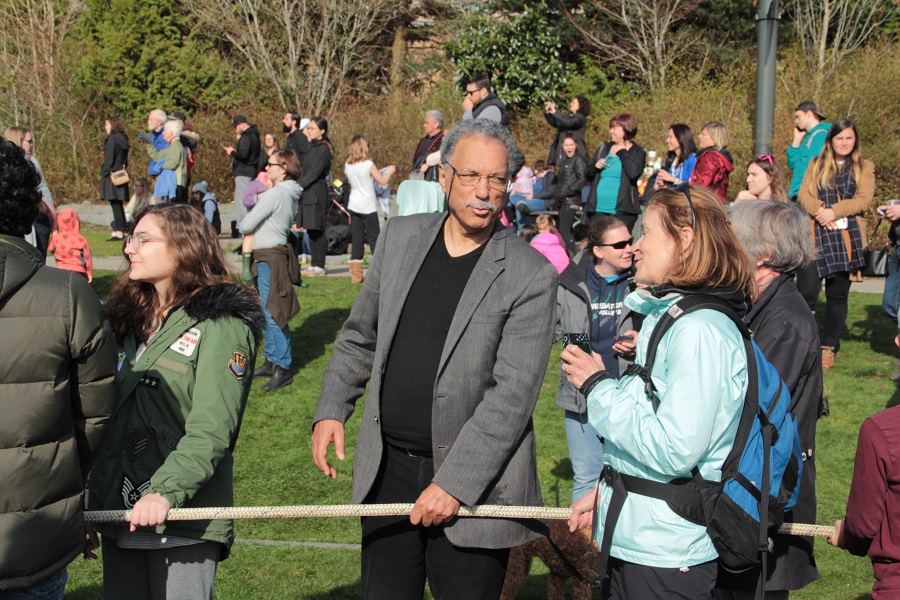
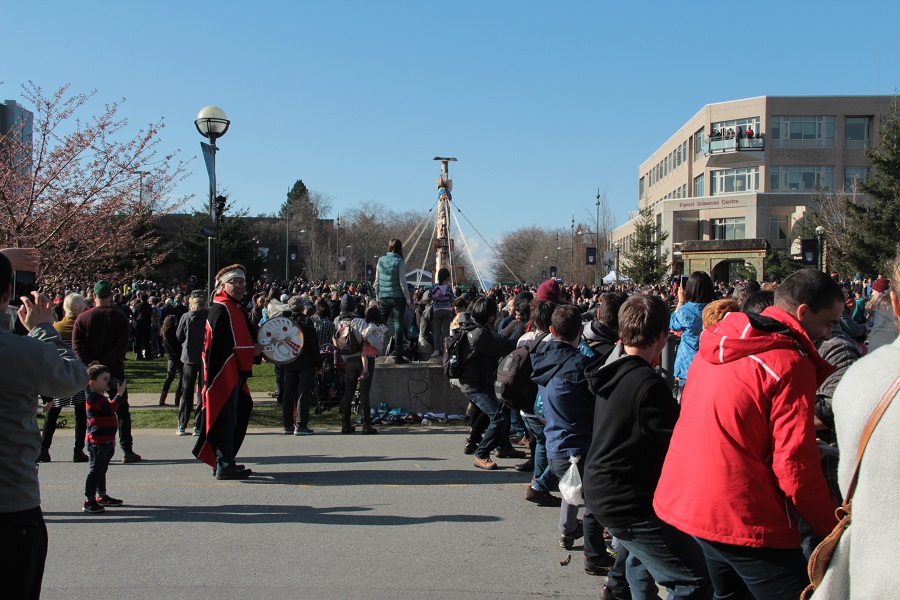
On April 1, 2017, a 17 m totem pole was raised at the south end of the University of British Columbia’s Main Mall. It is the Reconciliation Pole carved by Haida master carver and Hereditary Chief James Hart.

Hundreds of Vancouverites gathered for the event, which started at 1 p.m. with speeches by various First Nations dignitaries and dances. It was only shortly before 5 p.m. that the crowd -to which I belonged- on the small amphitheater to the south of the pole, was called on to tighten up the ropes that were laid along the field and connected to the semi-raised pole which was still resting on scaffolding.

Continue reading

The Sea Around Us expands its global presence

Dr. Dirk Zeller, lead of the Sea Around Us – Indian Ocean node

Dr. Dirk Zeller, lead of the Sea Around Us – Indian Ocean node. Photo by Valentina Ruiz Leotaud

We are proud to announce that Dr. Dirk Zeller, Senior Scientist and the Executive Director of the Sea Around Us has been appointed as Professor of Marine Conservation at the University of Western Australia (UWA), a new position created at the UWA School of Biological Sciences and the UWA Oceans Institute. Dr. Zeller’s appointment supports the establishment of the Sea Around Us – Indian Ocean node at UWA.

Continue reading

“An Ocean Mystery: The Missing Catch” to screen at UBC

Missing Catch invitation 2

Following its premiere on Earth Day at the Smithsonian National Museum of Natural History and on the Smithsonian Channel, award-winning ocean conservation film An Ocean Mystery: The Missing Catch will screen in Vancouver on April 28, 2017.

Join the Sea Around Us for this free screening at UBC’s Institute for the Oceans and Fisheries – in the AERL Lecture Theatre (Room 120), 2202 Main Mall. Screening will start at 11 a.m. RSVP REQUIRED.

Continue reading

Cautious fish evolve out of marine reserves

Photo by Matana_and_Jes, Flickr

Photo by Matana_and_Jes, Flickr

New research supports the creation of more marine reserves in the world’s oceans because, the authors say, fish can evolve to be more cautious and stay away from fishing nets.

The research suggests that by creating additional “no-take” areas, some fish will stay within marine reserves where they are protected from fishing. While other fish will move around the ocean, these less mobile fish will continue to live in the protected areas, pass this behaviour on to their offspring, and contribute to future generations, increasing the overall stock.

Continue reading

Making fisheries science accessible

Photo by Kyle Gillespie

Photo by Kyle Gillespie

Text by Madeline Cashion


Public speaking is an intimidating feat for pretty much everyone.

I am an extrovert who actively strives to listen more than talk (usually unsuccessfully…) while in conversation with any number of people, and yet I have a strong physical aversion to speaking in front of an audience in a professional setting. In part, this is because describing your science in a way that is accessible not only to other researchers but to a generalist, non-scientific audience is surprisingly tough. For example, terms that I use every day like gear, landings, discards, and exclusive economic zone are considered jargon to people who do not work with or study fisheries.

To a scientist, using common words in place of jargon seems imprecise and sensationalist. Science communication is difficult in any forum but can be almost impossible when you are in front of an audience and the immobilizing effects of the “fight or flight” response begin to eclipse your confidence.

Here’s a quick anecdote from a recent such experience of my own:

Continue reading