

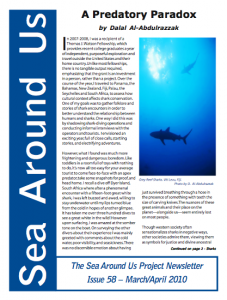
 Read about sea turtles, sharks, and Sea Around Us member research in the March/April newsletter.
Category: New & Notable
Biodiversity in Trouble
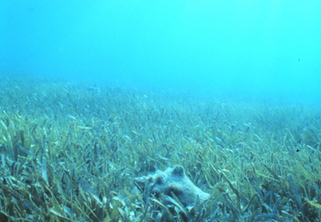 Sea Around Us Project members Daniel Pauly and Reg Watson contributed to a recent paper in Science that shows failure to achieve reductions in biodiversity loss by 2010 at outlined by the 2002 Convention on Biological Diversity (CBD). Most indicators of biodiversity show further declines while indicators of pressure, including spatial expansion of fisheries, show increases.
Sea Around Us Turns Ten
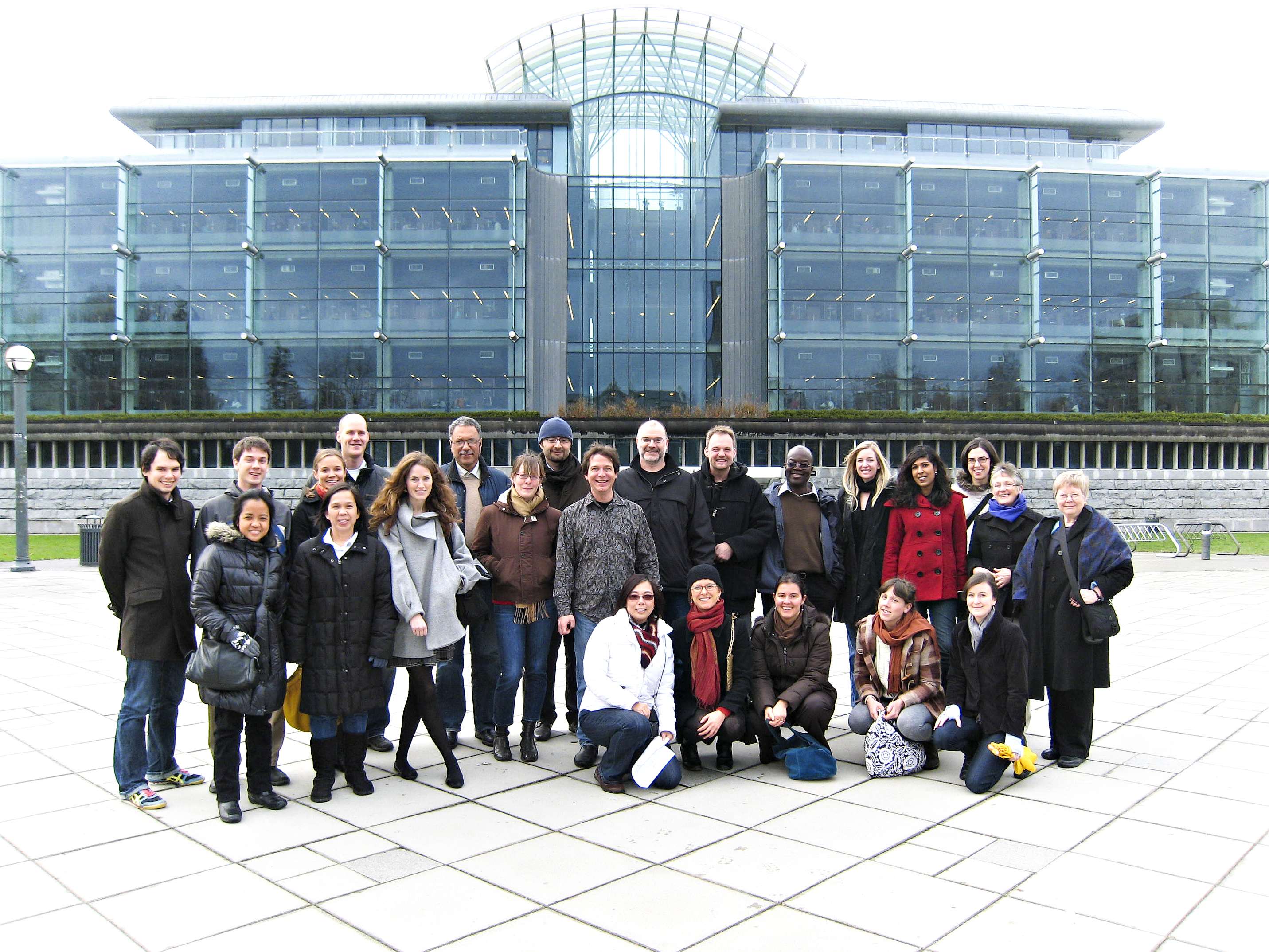 The year 2010 marks the 10th anniversary of the Sea Around Us Project and the production of a Ten-Year Retrospective Report. The report includes a forward by Josh Reichert, Managing Director of the Pew Environment Group, a full narrative of the project, a full list of publications, and the top ten accomplishments of the project, also listed here:
1. Created the first database in the world that assigns catch and derived information, such as catch values, to the areas where they originated, i.e., the Exclusive Economic Zones of specific countries, and Large Marine Ecosystems. This work, led by Dr Reg Watson, has made the Sea Around Us website the key source of spatialized fisheries information for the international scientific and environmental communities, accessed by thousands of users every month, and used for a wide range of products.
2. Mapped global marine fisheries catches since 1950 using a novel methodology, and established in the process that China, by over-reporting its catches, had masked a global decline of fisheries catches that started in the late 1980s. These results, published in the journal Nature, and later tacitly endorsed by FAO, provided the background for discussions about the global crisis of fisheries, e.g. as part of the Millennium Ecosystem Assessment.
3. Debunked, via reports presented at meetings of the International Whaling Commission and a ‘policy forum’ article in Science, the assertion promoted by the pro-whaling community that marine mammals and fisheries globally compete for fish and therefore that the culling of whales would make more fish available for human consumption.
4. Estimated the extent of subsidies to the fishing industry on a global basis and by subsidy type. Dr Rashid Sumaila, in collaboration with Oceana, an environmental NGO, was able to introduce these findings into WTO negotiations aiming at eliminating capacity-enhancing subsidies to fisheries.
5. Produced a series of papers investigating the successes and limitations of consumer awareness campaigns. This work, led by then Ph.D. student Jennifer Jacquet was among the first to question the effectiveness of consumer awareness campaigns on the seafood industry, and highlighted obstacles to these efforts, such as product mislabeling, and lack of metrics for measuring campaign effectiveness. Some of the market-based alternatives presented by the Sea Around Us have attracted the attention of several campaign groups.
6. Developed and applied a methodology for ‘reconstructing’ catch statistics from coastal countries, which generally yielded catch estimates much higher than those reported by the FAO. Catch reconstructions, led by Dr Dirk Zeller, have been, or are being completed for more than 80 countries. Results typically show that ‘small-scale’ fisheries contribute far more to the food security of developing countries than previously assumed, highlighting the need for a reassessment of policies that conventionally marginalize such fisheries.
7. Simulated, for the first time, the effect of climate change on fisheries and marine ecosystems on a global scale. Led by post-doctoral researcher Dr William Cheung (now a project collaborator based at the University of East Anglia, UK), the Sea Around Us demonstrated in a continuing series of papers how increases in ocean temperatures may lead to massive shifts in marine biodiversity and estimated ‘catch potentials’ of coastal countries.
8. Developed, using the Ecopath with Ecosim software, a technique for integrating global ecological and fisheries datasets. The development of this “database-driven construction of ecosystem models”, led by Dr Villy Christensen, may represent the most data-intensive integration in marine ecology today. It will be used in 2010 and beyond to derive time series of biomass and related information for all ecosystems in the global ocean, from 1950 to the present, and for projections under various global change scenarios.
9. Supported its principal investigator and main spokesperson, Dr Daniel Pauly, as he became recognized as a leading voice for ocean conservation, as evidenced by his being awarded, e.g., the International Cosmos Prize (Japan, 2005), the Volvo Environment Prize (Sweden, 2006), the Excellence in Ecology Prize (Germany, 2007), the Ramon Margalef Prize in Ecology (Spain, 2008), and numerous honorary doctorates.
10. Overall, the Sea Around Us turned into a respected voice on fisheries science, conservation, and policy. The Project, besides having published numerous influential reports and other non-peer-reviewed publications, has published or participated in over 160 articles in the peer-review literature since 2000 and the publication rate of our first five years more than tripled in the second 5 years to 25 peer-reviewed articles per year, with many highlighted in the media.
January/February 2010 Newsletter
 Read about bridging science and society, jellyfish, and all about our database update in the January/February newsletter.
November/December 2009 Newsletter
 Read about IUU fishing in the Baltic Sea, get a glimpse at the last 10 years of the Project, and see a summary of the 2009 publications from the Sea Around Us in the November/December newsletter.