
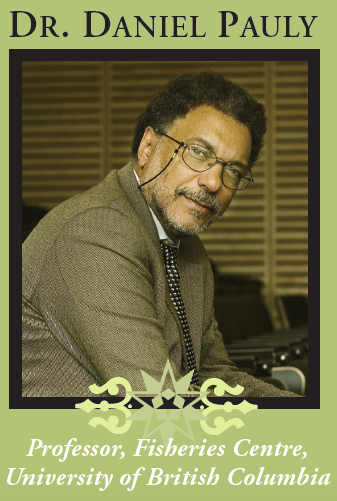
 On May 9, 2012, Daniel Pauly accepted the Nierenberg Prize — given annually by the Scripps Institution of Oceanography for outstanding contributions to science in the public interest.. Among the list of former are E.O. Wilson (2001), Jane Goodall (2004), James Hansen (2008), and NPR’s Ira Flatow (2010).
Category: Contact
From the Front Lines of the 2012 AAAS Meeting
 This post was written by by Claire Hornby, Sarah Harper, Robin Ramdeen, Dyhia Belhabib, Frédéric Le Manach and Aylin Ulman and appeared in the newsletter.
The American Association for the Advancement of Science (AAAS) held its 178th Annual Meeting in Vancouver from February 16-20, 2012. The theme of this year’s conference was “Flattening the world: building a global knowledge society”. Sea Around Us Project members were among the 8,000 attendees, participating and presenting in numerous symposium sessions and volunteering at the Project’s booth in the exhibition hall. Additional notable sessions were presented by other members of the Fisheries Centre.
Highlights from the conference included a symposium titled “Underreported yet overoptimistic: fisheries catch reconstructions and food security”, organized by Sea Around Us Project members Dr Dirk Zeller and Sarah Harper. Dirk gave an informative presentation outlining the methods used in reconstructing countries’ fisheries catches, while Frédéric Le Manach expanded on the importance of this task for tackling issues of human rights and ethics. Frédéric explained that fishing access agreements between the European Union and host countries, citing the example of Madagascar, are perpetuating socio-economic inequalities between most and least-developed countries. The catch reconstruction work for Madagascar made the first step toward revealing some of these inequalities, which suggest that fishing access agreements need to be revised to be more ethical.
In the final part of the session, Nicola Smith, a graduate of the University of British Columbia now working in the Caribbean, described her reconstruction of the catches of the Bahamas. She found that recreational fisheries catches, which account for a large
proportion of the country’s total catches, are entirely missing from official statistics. As is the case for much of the Caribbean, the economy of the Bahamas is dominated by tourism – visitors want to fish and eat seafood as part of their holiday experience. This places intense demand on the local marine environment. The take-home message of this symposium was that proper accounting of all fisheries sectors is a key component of managing fisheries resources in both a sustainable and ethical manner. The examples that Dirk, Frédéric and Nicola presented are just a handful of the 150 or so countries that will be reconstructed by the end of this year. There will definitely be many more interesting stories to tell once the reconstruction of catches for all fishing countries is complete!
Another successful symposium was “Whole-ocean economics” organized by Dr Rashid Sumaila. He revealed the newly developed Eco2 Index, which measures the economic and environmental health of developed and developing countries. Dr William Cheung also presented a conservation risk index that combines economic figures and fisheries population growth rates to reveal the economics/conservation trade-offs of fishing. It was clear from the model that not all developed countries are doing well in terms of conservation. The audience showed a particular interest in the “Whole-ocean economics” session and there was plenty of participation by professors, researchers, non-governmental organization representatives and students. A roundtable session followed the presentations and questions relating to fisheries, marine protected areas and governance generated stimulating discussions. This session succeeded in highlighting the commitment of the Fisheries Centre members to global research and collaboration.
Another symposium organized by the Sea Around Us Project was titled “Leveling the global playing field: global inferences from reliable global samples”. Dr Kristin Kleisner, a postdoctoral fellow with the Sea Around Us Project and organizer of the session, explained how to design sampling methods and why it is important to infer scientifically sound global trends. Dr Thomas Lovejoy, from the H. John Heinz III Center for Science, Economics, and the Environment in Washington DC, then discussed the use of technology to monitor biodiversity trends and species extinction. Closing the symposium, Dr Molly Jahn, from the University of Wisconsin, stressed the need to build a global information system to meet our future needs.
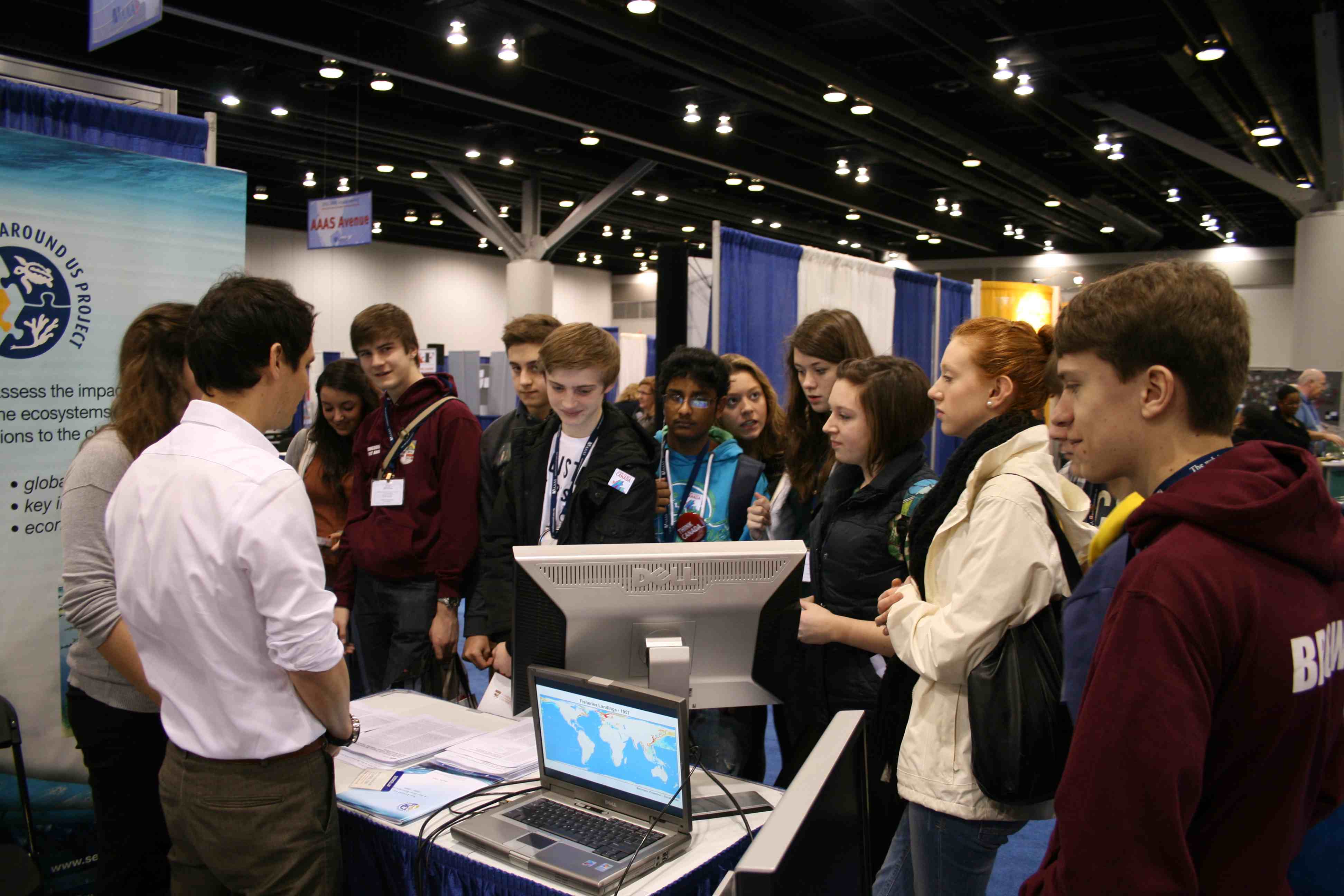
The Sea Around Us Project booth was also a major success. It allowed Project members to share their work with a diverse audience. For Claire Hornby, the AAAS was her first major science conference, and she was excited and nervous to have a chance to interact with scientists of various disciplines from all over the world. It was amazing to see the wide range of people that approached the booth, eager to hear about the Project’s work. Surprisingly, it seemed everyone – no matter if they were a budding scientist of five years old or an established professor – wanted to learn something about fisheries. The majority of attendees that approached the booth knew about the current state of the world’s oceans and the decline of many commercial fisheries. Family day at the AAAS brought many up-andcoming scientists to the booth. Robin Ramdeen, who volunteered that day, described how wonderful it was to see so many primary school children intrigued by the Sea Around Us Project’s display of ocean primary productivity. Their level of understanding of the importance of plankton for producing the energy upon which marine food webs are based was astounding. These inquisitive junior scientists answered their own questions about where energy comes from, both on land and at sea, and about how phytoplankton and zooplankton are essential to the diet of fish via the food web. Importantly, they were able to connect how changes in primary production could affect one of the ocean’s top predators: humans.
These were just a some of the highlights of Sea Around Us Project’s and the Fisheries Center’s contributions to the 2012 AAAS meeting. The conference was yet another example of how committed the Sea Around Us Project is not only to doing good research, but also to communicating its work to the world.
TED Talk: Daniel Pauly on Shifting Baselines
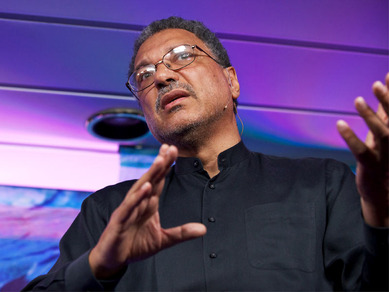 Daniel Pauly’s TED talk on Shifting Baselines is finally up! Watch the video, or read the transcript below:
I’m going to speak about a tiny, little idea. And this is about shifting baseline. And because the idea can be explained in one minute, I will tell you three stories before to fill in the time. And the first story is about Charles Darwin, one of my heroes. And he was here, as you well know, in ’35. And you’d think he was chasing finches, but he wasn’t. He was actually collecting fish. And he described one of them as very “common.” This was the sailfin grouper. A big fishery was run on it until the ’80s. Now the fish is on the IUCN Red List. Now this story, we have heard it lots of times on Galapagos and other places, so there is nothing particular about it. But the point is, we still come to Galapagos. We still think it is pristine. The brochures still say it is untouched. So what happens here?
The second story, also to illustrate another concept, is called shifting waistline. (Laughter) Because I was there in ’71, studying a lagoon in West Africa. I was there because I grew up in Europe and I wanted later to work in Africa. And I thought I could blend in. And I got a big sunburn, and I was convinced that I was really not from there. This was my first sunburn.
And the lagoon was surrounded by palm trees, as you can see, and a few mangrove. And it had tilapia about 20 centimeters, a species of tilapia called blackchin tilapia. And the fisheries for this tilapia sustained lots of fish and they had a good time and they earned more than average in Ghana. When I went there 27 years later, the fish had shrunk to half of their size. They were maturing at five centimeters. They had been pushed genetically. There were still fishes. They were still kind of happy. And the fish also were happy to be there. So nothing has changed, but everything has changed.
My third little story is that I was an accomplice in the introduction of trawling in Southeast Asia. In the ’70s — well, beginning in the ’60s — Europe did lots of development projects. Fish development meant imposing on countries that had already 100,000 fishers to impose on them industrial fishing. And this boat, quite ugly, is called the Mutiara 4. And I went sailing on it, and we did surveys throughout the southern South China sea and especially the Java Sea. And what we caught, we didn’t have words for it. What we caught, I know now, is the bottom of the sea. And 90 percent of our catch were sponges, other animals that are fixed on the bottom. And actually most of the fish, they are a little spot on the debris, the piles of debris, were coral reef fish. Essentially the bottom of the sea came onto the deck and then was thrown down.
And these pictures are extraordinary because this transition is very rapid. Within a year, you do a survey and then commercial fishing begins. The bottom is transformed from, in this case, a hard bottom or soft coral into a muddy mess. This is a dead turtle. They were not eaten, they were thrown away because they were dead. And one time we caught a live one. It was not drowned yet. And then they wanted to kill it because it was good to eat. This mountain of debris is actually collected by fishers every time they go into an area that’s never been fished. But it’s not documented.
We transform the world, but we don’t remember it. We adjust our baseline to the new level, and we don’t recall what was there. If you generalize this, something like this happens. You have on the y axis some good thing: biodiversity, numbers of orca, the greenness of your country, the water supply. And over time it changes — it changes because people do things, or naturally. Every generation will use the images that they got at the beginning of their conscious lives as a standard and will extrapolate forward. And the difference then, they perceive as a loss. But they don’t perceive what happened before as a loss. You can have a succession of changes. At the end you want to sustain miserable leftovers. And that, to a large extent, is what we want to do now. We want to sustain things that are gone or things that are not the way they were.
Now one should think this problem affected people certainly when in predatory societies, they killed animals and they didn’t know they had done so after a few generations. Because, obviously, an animal that is very abundant, before it gets extinct, it becomes rare. So you don’t lose abundant animals. You always lose rare animals. And therefore they’re not perceived as a big loss. Over time, we concentrate on large animals, and in a sea that means the big fish. They become rarer because we fish them. Over time we have a few fish left and we think this is the baseline.
And the question is, why do people accept this? Well because they don’t know that it was different. And in fact, lots of people, scientists, will contest that it was really different. And they will contest this because the evidence presented in an earlier mode is not in the way they would like the evidence presented. For example, the anecdote that some present, as Captain so-and-so observed lots of fish in this area cannot be used or is usually not utilized by fishery scientists, because it’s not “scientific.” So you have a situation where people don’t know the past, even though we live in literate societies, because they don’t trust the sources of the past.
And hence, the enormous role that a marine protected area can play. Because with marine protected areas, we actually recreate the past. We recreate the past that people cannot conceive because the baseline has shifted and is extremely low. That is for people who can see a marine protected area and who can benefit from the insight that it provides, which enables them to reset their baseline.
How about the people who can’t do that because they have no access — the people in the Midwest for example? There I think that the arts and film can perhaps fill the gap, and simulation. This is a simulation of Chesapeake Bay. There were gray whales in Chesapeake Bay a long time ago — 500 years ago. And you will have noticed that the hues and tones are like “Avatar.” (Laughter) And if you think about “Avatar,” if you think of why people were so touched by it — never mind the Pocahontas story — why so touched by the imagery? Because it evokes something that in a sense has been lost. And so my recommendation, it’s the only one I will provide, is for Cameron to do “Avatar II” underwater.
Thank you very much.
TED Talk: Daniel Pauly on Shifting Baselines
 Daniel Pauly’s TED talk on Shifting Baselines is finally up! Watch the video, or read the transcript below:
I’m going to speak about a tiny, little idea. And this is about shifting baseline. And because the idea can be explained in one minute, I will tell you three stories before to fill in the time. And the first story is about Charles Darwin, one of my heroes. And he was here, as you well know, in ’35. And you’d think he was chasing finches, but he wasn’t. He was actually collecting fish. And he described one of them as very “common.” This was the sailfin grouper. A big fishery was run on it until the ’80s. Now the fish is on the IUCN Red List. Now this story, we have heard it lots of times on Galapagos and other places, so there is nothing particular about it. But the point is, we still come to Galapagos. We still think it is pristine. The brochures still say it is untouched. So what happens here?
The second story, also to illustrate another concept, is called shifting waistline. (Laughter) Because I was there in ’71, studying a lagoon in West Africa. I was there because I grew up in Europe and I wanted later to work in Africa. And I thought I could blend in. And I got a big sunburn, and I was convinced that I was really not from there. This was my first sunburn.
And the lagoon was surrounded by palm trees, as you can see, and a few mangrove. And it had tilapia about 20 centimeters, a species of tilapia called blackchin tilapia. And the fisheries for this tilapia sustained lots of fish and they had a good time and they earned more than average in Ghana. When I went there 27 years later, the fish had shrunk to half of their size. They were maturing at five centimeters. They had been pushed genetically. There were still fishes. They were still kind of happy. And the fish also were happy to be there. So nothing has changed, but everything has changed.
My third little story is that I was an accomplice in the introduction of trawling in Southeast Asia. In the ’70s — well, beginning in the ’60s — Europe did lots of development projects. Fish development meant imposing on countries that had already 100,000 fishers to impose on them industrial fishing. And this boat, quite ugly, is called the Mutiara 4. And I went sailing on it, and we did surveys throughout the southern South China sea and especially the Java Sea. And what we caught, we didn’t have words for it. What we caught, I know now, is the bottom of the sea. And 90 percent of our catch were sponges, other animals that are fixed on the bottom. And actually most of the fish, they are a little spot on the debris, the piles of debris, were coral reef fish. Essentially the bottom of the sea came onto the deck and then was thrown down.
And these pictures are extraordinary because this transition is very rapid. Within a year, you do a survey and then commercial fishing begins. The bottom is transformed from, in this case, a hard bottom or soft coral into a muddy mess. This is a dead turtle. They were not eaten, they were thrown away because they were dead. And one time we caught a live one. It was not drowned yet. And then they wanted to kill it because it was good to eat. This mountain of debris is actually collected by fishers every time they go into an area that’s never been fished. But it’s not documented.
We transform the world, but we don’t remember it. We adjust our baseline to the new level, and we don’t recall what was there. If you generalize this, something like this happens. You have on the y axis some good thing: biodiversity, numbers of orca, the greenness of your country, the water supply. And over time it changes — it changes because people do things, or naturally. Every generation will use the images that they got at the beginning of their conscious lives as a standard and will extrapolate forward. And the difference then, they perceive as a loss. But they don’t perceive what happened before as a loss. You can have a succession of changes. At the end you want to sustain miserable leftovers. And that, to a large extent, is what we want to do now. We want to sustain things that are gone or things that are not the way they were.
Now one should think this problem affected people certainly when in predatory societies, they killed animals and they didn’t know they had done so after a few generations. Because, obviously, an animal that is very abundant, before it gets extinct, it becomes rare. So you don’t lose abundant animals. You always lose rare animals. And therefore they’re not perceived as a big loss. Over time, we concentrate on large animals, and in a sea that means the big fish. They become rarer because we fish them. Over time we have a few fish left and we think this is the baseline.
And the question is, why do people accept this? Well because they don’t know that it was different. And in fact, lots of people, scientists, will contest that it was really different. And they will contest this because the evidence presented in an earlier mode is not in the way they would like the evidence presented. For example, the anecdote that some present, as Captain so-and-so observed lots of fish in this area cannot be used or is usually not utilized by fishery scientists, because it’s not “scientific.” So you have a situation where people don’t know the past, even though we live in literate societies, because they don’t trust the sources of the past.
And hence, the enormous role that a marine protected area can play. Because with marine protected areas, we actually recreate the past. We recreate the past that people cannot conceive because the baseline has shifted and is extremely low. That is for people who can see a marine protected area and who can benefit from the insight that it provides, which enables them to reset their baseline.
How about the people who can’t do that because they have no access — the people in the Midwest for example? There I think that the arts and film can perhaps fill the gap, and simulation. This is a simulation of Chesapeake Bay. There were gray whales in Chesapeake Bay a long time ago — 500 years ago. And you will have noticed that the hues and tones are like “Avatar.” (Laughter) And if you think about “Avatar,” if you think of why people were so touched by it — never mind the Pocahontas story — why so touched by the imagery? Because it evokes something that in a sense has been lost. And so my recommendation, it’s the only one I will provide, is for Cameron to do “Avatar II” underwater.
Thank you very much.