 by Dyhia Belhabib
“Our driftnets don’t produce discards.”
“We don’t have illegal fishing – it’s illegal.”
“Your methods are correct, but your results don’t make sense.”
“Don’t tell them we fish in their waters, they will deny us access.”
These were some of the amazing comments I heard during my short visit to seven West African countries earlier this year as part of the “Sea Around Us Project and PRCM: Marine Conservation Research, Collaboration and Support in West Africa.” (PRCM is the Regional Marine and Coastal Conservation Programme for West Africa). During my trip, I met with fisheries experts, researchers, decision-makers, NGOs and industry representatives to ground-truth the catch reconstruction results for the different countries.
I landed in Dakar on 4 April and met with the USAID Collaborative Management of Sustainable Fisheries in Senegal (COMFISH) team early the next day. Going through the presentation of Christopher Mathews (director of USAID/COMFISH in Senegal) for the upcoming meetings, made me realize how sensitive the subject of catch reconstructions was, and how diplomatic I would need to be. I would have to choose my words wisely.
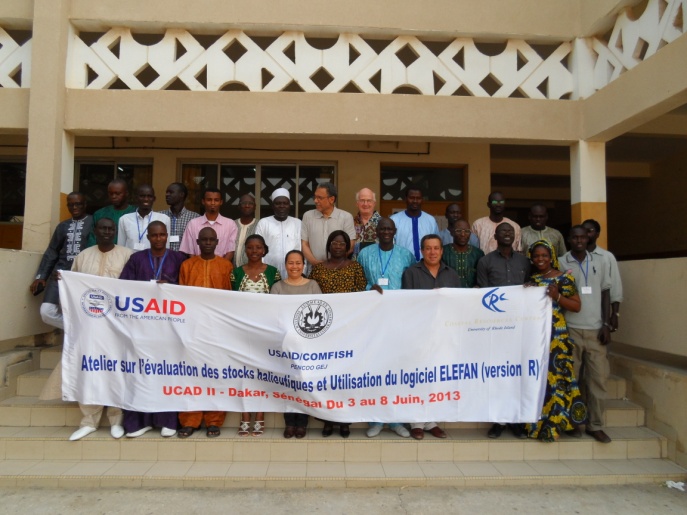
The morning of April 6th, the Senegal workshop began. Around 85 people showed up, notably, the Department of Fisheries (DPM), the Fisheries Research Institute (CRODT), WWF, industrial and artisanal fisheries representatives, the Department of Fisheries Monitoring and Surveillance (DPSP), the US Navy, the local university and women from the fish processing industry, as well as the media. The main goal of the workshop was to validate catch reconstruction results and identify potential collaborators under the project in West Africa. I remembered that in 2012, Senegal denied the existence of any illegal activities in its waters and under-reporting as well, so we had to show some examples to demonstrate that Senegal was not an exception. With Duncan Copeland, our coordinator in West Africa, we prepared a “why bother?” presentation where we brainstormed with the audience on illegal fishing and under-reporting.
The following day, I presented technical details and major results of the catch reconstruction, along with the first estimates of illegal, unreported and unregulated (IUU) fishing. Dougoutigui Koulibaly, the executive secretary of the Industrial Fisheries Association had a comment, and I was preparing myself to be really diplomatic and nice. He said: I couldn’t eat lunch; if your estimations are remotely correct – and according to the audience, they seem to make sense – we are in trouble and we need to act now. I thought that we had come a long way from last year’s sentiment of, “We don’t have illegal fishing – it’s illegal.” One of the recommendations resulting from the workshop that had to be sent to the minister of fisheries was to create a working group to validate the results by 15 May. Senegal was ready to move ahead, and the people from the administration showed a strong will to participate.
Our next stop: Nouadhibou, Mauritania. We landed in Nouakchott, the capital city, and drove across the stunning, sandy desert to Nouadhibou to meet with staff of IMROP, the Mauritanian Institute of Fisheries Research. The meeting, although very casual, took around four hours and we discussed every single point of the methods. The organiser had us meet with the Association of Artisanal Cephalopod Fishermen with whom I used some mixed academic-Algerian Arabic to make myself understood. I implanted keywords such as “domestic,” “industrial“ and “China” in their minds, waiting for them to blow up. It didn’t work that well, as the fishers told me they didn’t believe the fishing access agreement with China would be of any benefit or harm to them. The fact that China is building infrastructure in the ports probably helped them forget the negative impacts of overfishing. But they said they had noticed shrinking fish sizes, shrinking catches and shrinking prices. We met with the subsistence fishing community and asked about their fishing traditions so that we could consider this community in our reconstruction of fisheries history. While the representative of the national federation told us that they don’t have under-reporting anymore, and illegal fishing is rare, his colleague said they don’t know what is happening in their waters, and there is probably discarding and illegal fishing. Two very different versions; the most realistic one
was obvious.
On our way back to Nouakchott, we stopped for around 15 minutes at the beautiful National Park of the Banc D’arguin (PNBA). I couldn’t possibly go to West Africa without stopping at its most famous national park, where overfishing in the adjacent waters has severely depleted fisheries resources.
I managed to get to Monrovia by traveling from Mauritania through Abidjan (Côte d’Ivoire), then Accra (Ghana) before heading back towards Liberia. It was a ridiculous, 48 hour-long trip. I arrived in Monrovia, hardly looking like a human being, and about one hour later, I had the pleasure of meeting with the Bureau of National Fisheries (BNF). One-on-one meetings, it turned out, were the best choice for confirming or contradicting the information others could have given me. The SeaMen Workers Union, a group representing the benefits of workers in the fishing industry, talked about industrial discards and illegal Chinese pair trawling in Liberia. Coordinators and project managers talked about non-commercial fisheries, and the statistics division provided data on discards, transshipping and the real ownership of vessels. Liberia was one of the most challenging countries to reconstruct catches for, as information was scarce. Now it has been enriched by solid, if anecdotal, knowledge. Recently I also learned that after months of battling and collaboration with East African countries, Liberia has won a $2-million case against a Korean operator fishing illegally in its waters!
Crossing the border is always a pain in West Africa; however, the Liberia-Leonean border guards were surprisingly nice and welcoming. The beauty of the villages and the smiles of the children waving at us made the trip less painful and reduced the stress caused by our car breaking down in the middle of the bush. We finally made it to Freetown. The next day, we went to the Ministry of Fisheries, where I had the pleasure of meeting the deputy minister, and a while later, the minister himself. Thereafter we headed up to Guinea – the black hole of illegal fishing in Africa. Before even crossing the border, the friendly Sierra Leone immigration agents warned us: “They are hostiles.”
Indeed, I would add that the country is not only the black hole of illegal fishing, but of corruption, as it was present even in the lowest levels of society. Alkaly Dooumbouya, our collaborator from the fisheries research institute of Conakry (Centre National des Sciences halieutiques de Boussoura; CNSHB) organized a workshop inviting the department of surveillance, university representatives, the ministry of fisheries and the CNSHB. However, it was more appropriate to meet Mr Kaba, the representative of artisanal fisheries, before the workshop, to grasp a realistic picture of fisheries in Guinea. From Mr Kaba, we learned about the politics of fisheries in Guinea, and that the minister of fisheries himself had a fishing company whose vessels were often spotted off Sierra Leone! To tackle this conflict of interest, a new department of surveillance was created under the supervision of the Préfet maritime, an important figure who made himself available for a meeting after the workshop. I also had the pleasure of meeting with some of the legends of fisheries in West Africa, like Ibrahima Diallo, a Guinean fisheries scientist who worked on establishing time series for Guinean fisheries despite many technical and financial challenges. We discussed our research, and in general, people agreed with the methods and partial results, were shocked by the cumulative graphs, but finally accepted the overall outcomes.
After seven nights in Conakry, I was more than relieved to leave Guinea, just because of the perpetual harassment by police officers and immigration agents, some of whom were former mercenaries for Kaddafi.
I was happy finally to see the Bissau-Guinean flag. The immigration checkpoint was in a little village with a friendly imam checking passports. (It occurred to me that this might be an easy way in for drug dealers, as Guinea Bissau is coming to be known as the new Columbia of the world.) Once at the hotel, there was barely enough power for internet access, but we could contact our collaborators from the Bissau-Guinean ministry of fisheries and organise a meeting over Easter – a four-day holiday for 13% of the population that makes the entire nation happy. Meanwhile, we met with local experts from IUCN and discussed possible collaborations, especially on the topic of marine protected areas. We presented our results to Dr Victorino Nahada, the head of the fisheries department. He understood the basic concept and the rationale, as well as the data we used. He didn’t have any negative nor positive comments, but said politely that Guinea-Bissau doesn’t have an industrial fleet, they don’t land here and transhipping is illegal. Then we showed him our satellite pictures of a reefer (refrigerated container ship) operating consistently in Guinea-Bissau waters…
After a stop in The Gambia, I was getting ready to return to Vancouver where a lot of follow-up work was waiting for me. My journey in West Africa could be summarized as productive, intense, emotional and sometimes frustrating, but with a happy ending. I grew up during this intense one-month trip of workshop organisation, presentations and interviews, questioning and interrogations in seven countries of West Africa – amongst them some of the poorest countries in the world. I also learned how difficult it is to be a woman in the manly world of fisheries. I learned to be patient and diplomatic – an aspect of my character that I hadn’t known of myself before. I learned to interview people on very controversial topics and to gain their trust. I was particularly proud to get some of these countries out of their denial concerning illegal fisheries. By the end, I was deemed to be the Ambassador of the Sea Around Us Project in West Africa.


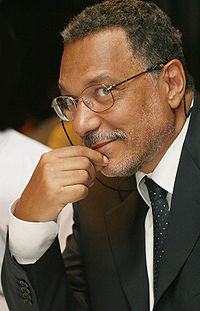 The Sea Around Us Project’s Principal Investigator, Daniel Pauly, has been elected a fellow of the American Association for the Advancement of Science (AAAS). He is among three UBC researchers to be named this year.