

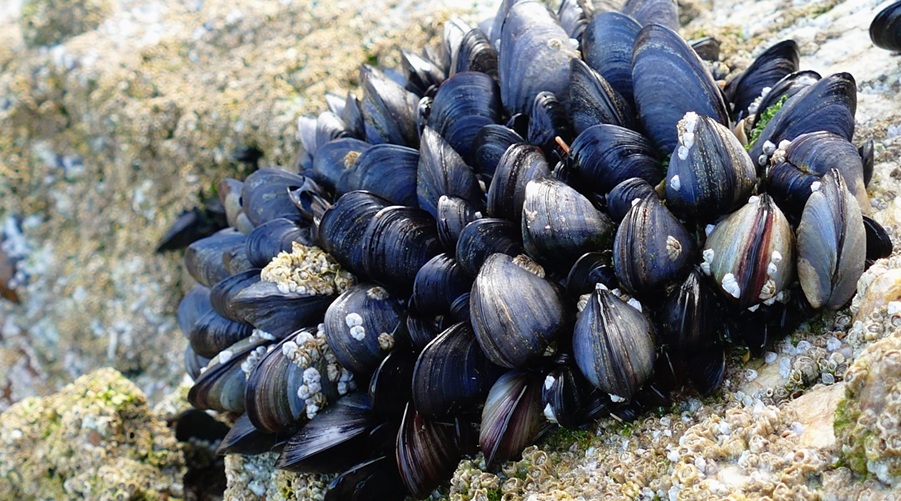
Mussels. Image from Pxhere.
Marine and freshwater invertebrates – such as clams, mussels, scallops, crabs, and even jellyfish – are exceptionally nutrient-dense and could meet the annual nutrient requirements of billions of people, provided that they are harvested and produced sustainably.
In a recent paper published in Nature, an international team of researchers quantified the contribution of aquatic invertebrates to global nutrient supplies and discovered that current production delivers the equivalent annual requirement for over 5 billion people in terms of vitamin B12 and selenium; over 1 billion people for copper, omega-3 fatty acids, iodine and zinc; and over 100 million people for nutrients such as vitamins B2 and B3, iron, manganese and magnesium.
To assess this type of seafood’s potential provision of 30 key nutrients for human health, the researchers used reconstructed marine fisheries data from UBC’s Sea Around Us initiative and reported inland and aquaculture production data from the Food and Agriculture Organization. Then, they integrated all these data with the nutrient composition data in the Aquatic Food Composition Database. They focused on the year 2019, as it was the most recent for which reconstructed fisheries catch data were available.
“Despite their established importance, most aquatic invertebrates are grossly under-represented in fishery conservation and nutritional assessments,” said Dr. Jessica Zamborain-Mason, lead author of the study and an assistant professor at the King Abdullah University of Science and Technology. “Most of the world’s population does not ingest enough micronutrients such as vitamin B12, iron and zinc in their diets. Our study highlights the nutritional value of invertebrate aquatic foods and could be used to inform public health programs and policies aimed at addressing undernourishment.”
Relative to their production volumes, invertebrates greatly contributed to the supply of essential nutrients. In the case of marine capture fisheries, their volume was about 15 per cent of the total caught, yet they supplied over 30 per cent of vitamin C and manganese; over 25 per cent of folate, selenium and sodium; and over 16 per cent of chromium, magnesium, vitamin E, iron, vitamin B12 and phosphorus needs. Similar nutrient supply-biomass disproportions of nutrient versus biomass supplies were observed for inland fisheries and aquaculture.
“We also examined how the nutrient concentration of aquatic invertebrates varies across taxonomic groups, consumption patterns -that is, the body parts that are sampled and the way they are processed- and environmental and life-history factors like the habitat or thermal regime the species lives in,” Dr. Zamborain-Mason said. “We found different groups differ in nutrient concentrations; for example, bivalves had the highest concentration of iron, iodine, zinc and vitamin B12, while sea urchins were richer in other nutrients such as selenium and magnesium.”
The researchers then used predictive modelling to estimate and provide the nutrient composition of over 50,000 invertebrate species found in SeaLifeBase (SLB). Most of these species have never been nutritionally examined in this way before, and the results, which will be available in SLB, can be used to start accounting for their nutritional value in conservation, management and policy.
Addressing policy implementation, the study notes that any work in this area should pay attention to the sustainable supply of invertebrates, both in terms of ecosystem considerations and equitable distribution to those who most need them.
“The potential nutritional benefits we studied depend on sustainable invertebrate supplies, and halting current invertebrate declines in the case of marine fisheries,” said Dr. Maria ‘Deng’ Palomares, co-author of the paper and manager of the Sea Around Us initiative. “The nutritional contributions we documented should not be interpreted as justification for increased exploitation, but rather as an additional argument for conserving and sustainably managing aquatic invertebrates, their diversity and the ecosystems that underpin their production.”
For Dr. Palomares, aquatic invertebrates not only represent an important and varied source of nutrients, but they also have diverse environmental, social and economic dimensions that contribute to nutrition security as well.
“They are a nutrient-rich food that is culturally appropriate and accessible in many locations, with high production potential at relatively low cost. Policies that enhance their sustainable production and access can tackle multiple environmental and socioeconomic targets simultaneously, for example, zero hunger, responsible consumption and production, and gender equality, as gleaning in the context of fisheries is most commonly performed by women, particularly in developing countries,” Dr. Palomares said.
The paper “The nutritional value of invertebrate aquatic foods” is available as open-access in Nature https://doi.org/10.1038/s41586-026-10908-7