New app to simplify fisheries data collection

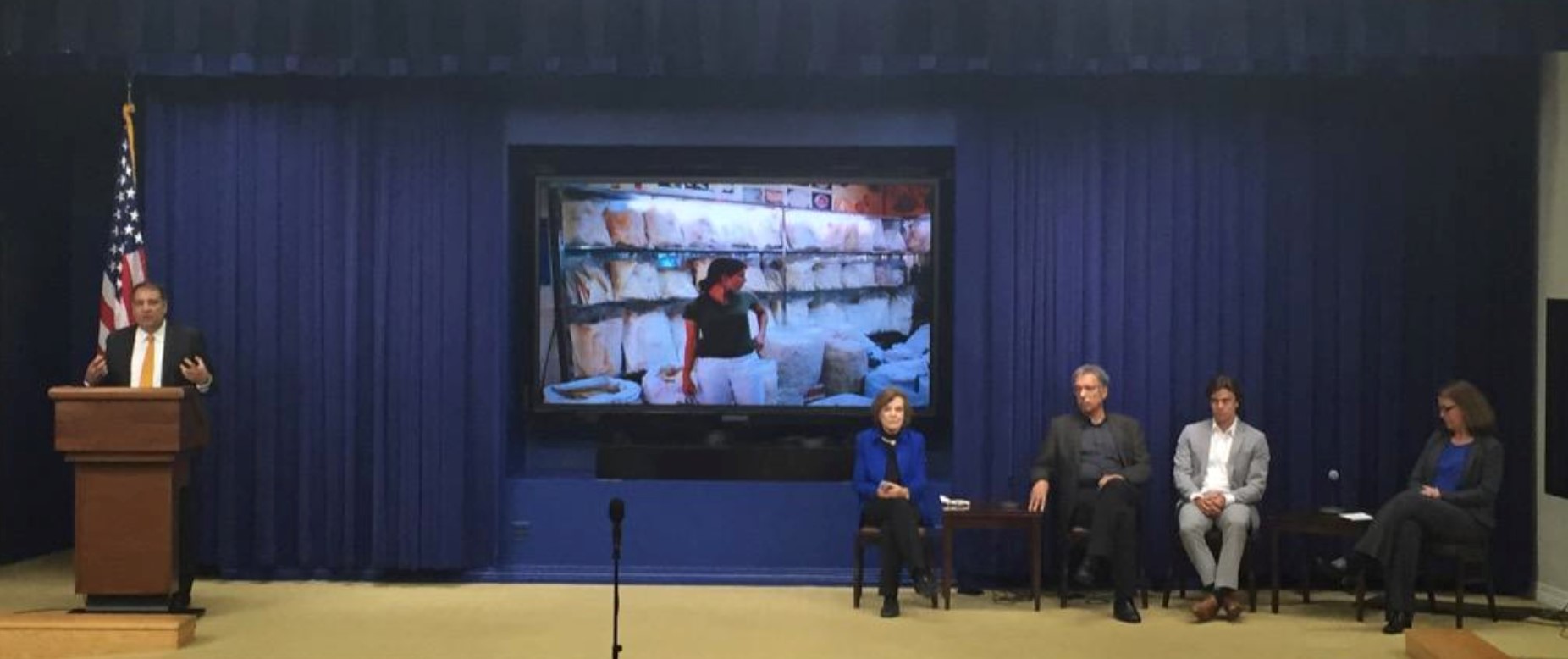
Dr. Box presents the Fish Landing app to a workshop at the FishBase symposium in the Philippines. The workshop was co-sponsored by Oceana Philippines, the Philippine (), and Sea Around Us.

Dr. Box from the Smithsonian Institution presents the Fish Landing app during a workshop at the FishBase symposium in the Philippines associated with the 25th and 10th year anniversaries of FishBase and SeaLifeBase (Sea Around Us partners). The workshop was co-sponsored by the FishBase Information and Research Group (FIN), Oceana-Philippines, the Bureau of Fisheries and Aquatic Resources (BFAR) of the Philippine Department of Agriculture, and the Sea Around Us.

On the northern coast of Honduras local fishers noticed the amount of fish they caught was decreasing year after year. What’s more, it was becoming increasingly difficult to catch the amount of fish they needed to make a living.

Compounding their plight was the fact that because their catch went to local buyers and then on to domestic markets—no real catch data were available. Without these data, it is incredibly difficult to manage a sustainable fishery.

A new app could help change this. The Fish Landing app helps local buyers track the species and size of fish caught, fishing spots frequently used, and the profiles of local fishers.

The app was developed by a team of researchers from the Center of Marine Studies (CEM), and the Smithsonian Institution, led by Dr. Stephen Box from the Smithsonian.

“The wealth of data which will be collected using these tools will greatly contribute to data analysis, and can be a primary basis for any plans related to fisheries management and sustainability,” said Dr. Box at the workshop, which was organized and moderated by Dr. Deng Palomares.

The researchers initially used a paper-based system to try and track catch data, where fishers, upon returning from the ocean, would fill out forms detailing the number and species of fish they caught. At the end of each month these papers were given to researches who then laboriously digitized and analyzed the data. While relatively effective for some small communities, on a larger scale it was highly inefficient.

The Fish Landing app helps to streamline this process. Local buyers—who receive the majority of fish from the fishers—use an Android phone or iPad to keep track of the data. Through its picture-based operation system the app is easy to use.

But why would buyers want to participate? The app is a one-stop shop for business purposes, where buyers can track fish caught, money earned and paid, and who their clients are. Fishers also get more precise information about what and how much they catch and earn, and governments are given data that can be used for fisheries statistics. Data packages to be shared with governments or management agencies can be customized and adjusted to local needs and sensitivities.

Furthermore, governments will finally be able to understand the large role that small-scale fishers play in contributing to the economy and food security.

At the workshop where Dr. Box presented the Fish Landing app, two other closely-associated tools were also presented. These included a decentralized registration system that easily and rapidly creates “fisher identity cards.” Often, these are the only pieces of ID that the fishers possess.

The other tool is an onboard, cheap, self-contained, and solar powered GPS system that will help in understanding the amount of time fishers spend in certain waters, the competition for fishing grounds among fishers, and the seasonal patterns in seascape use, among a suite of other factors.

Daniel Pauly, Principal Investigator of the Sea Around Us, believes these tools together could transform the accumulation of fisheries data.

“These three items could revolutionize data acquisition for and by artisanal fishers in developing countries, including the Philippines where the presentation by Dr. Stephen Box generated considerable interest,” he said.

Dirk Zeller, Senior Scientist of the Sea Around Us, thinks these tools are a state of the art approach that not only improve data collection but also the management of small-scale fisheries, which recently received clear recognition through an endorsement by the Committee on Fisheries and Aquaculture (COFI), of the FAO’s Voluntary Guidelines for Securing Sustainable Small-Scale Fisheries in the Context of Food Security and Poverty Eradication.

“These tools and their associated direct and easy access to the data generated, will also empower local communities in their engagement in small-scale fisheries management,” he said.

The app and related tools are also being tested in Myanmar. Interest from the Philippine government and some NGOs expressed at the workshop may lead to the use of the fisheries app package, at least in some pilot areas. Dr. Mary Ann Bimbao (Executive Director of FIN) and Dr. Deng Palomares (Senior Scientist of the Sea Around Us) are in follow-up discussions with some members of the BFAR and Oceana-Philippines for future work.

Daniel Pauly participates in international fishing documentary

IMG_0648-min

Daniel Pauly on set in Newfoundland, Canada. Photo credit: Rick Stanley

Daniel Pauly recently returned from Newfoundland, Canada, where he was working on an international fishing documentary.

The film, produced by the Khaled bin Sultan Living Ocean Foundation near Washington D.C., will be filmed in five locations including Honduras, South America, the U.S., Bahamas, Senegal, Africa,  — and, of course, Newfoundland, Canada.

As Pauly explains, the film explores the role of small-boat fishermen and how they contribute to the economy.

“There is a lack of awareness from the government,” he says. “They don’t understand how these fisherman fit into the economy, and so they tend to favour bigger fishing companies.”

Pauly is the film’s on-camera investigator who also serves as link between the countries.

The film is currently in production and is aiming for release in spring 2016.


Sea Around Us attends meeting to support conservation assessment for Antarctica and the Southern Ocean

A senior researcher with the Sea Around Us recently attended a three-day meeting earlier this month to discuss conservation of biodiversity with Antarctic experts in Monaco.

Deng Palomares, who recently worked on an Antarctic report for the Sea Around Us, said the meeting was an important step in identifying and assuring that Antarctic research focuses on the gaps in current data.

Monaco_Assessment_group_with_HSH_PAII_sm

“It was a very successful endeavour seeing that the experts who participated in the assessment came from a multidisciplinary background,” Palomares said. “One of the most significant contributions of those three days is the engagement promised by these experts to continue their work in the Antarctic.”

Co-organized by the Government of the Principality of Monaco, the Centre Scientifique de Monaco, SCAR, and Monash University, the meeting was meant to assess whether the conservation of the biodiversity of Antarctica and the Southern Ocean is meeting the targets of the Strategic Plan for Biodiversity 2011-2020.

The meeting also aimed to provide guidance for action that can effectively help deliver further conservation successes for the regions. Another goal was to identify key areas for work and indicators to help guide that work, which resulted in the Antarctica and the Strategic Plan for Biodiversity 2011-2020: The Monaco Assessment.

“The initial expert assessment indicates a biodiversity outlook for Antarctica and the Southern Ocean which is no better than that for the rest of the globe,” said professor Steven Chown of Monash University, who co-organized the meeting.

HSH Prince Albert II of Manaco, who closed the meeting June 10, emphasized that activity in the Antarctic region — including not only fishing and tourism, but also some scientific activities — has drastically increased.

“I am convinced that common action from all countries and parties, can improve the situation for the better,” HSH Prince Albert II of Monaco noted. “I can assure you that my Government and my Foundation will make every effort possible to ensure that science continues to prevail in this land with international cooperation”

Organizers and attendees left feeling hopeful that there will be effective action over the next five years to dramatically improve the state of biodiversity in Antarctica and the Southern Ocean.

You can read more on The Monaco Assessment here


13th Annual FishBase Symposium in Philippines to take place this fall

FishBase_Symposium_Vancouver_Sept_2014-min

A group shot from the 2014 FishBase Symposium that took place at the University of British Columbia in Vancouver.

The 13th annual FishBase Symposium will take place September 1, 2015, hosted by the FishBase Information and Research Group, Inc. (FIN) in Los Baños, Philippines to mark the 25th and 10th year anniversaries of FishBase and SealifeBase, respectively.

Convened by Drs Mary Ann Bimbao (FIN) and Deng Palomares, Sea Around Us Senior Scientist, the theme for the Symposium is FishBase and SeaLifeBase for Teaching and Research in Aquatic Science. It aims to promote a deeper understanding of why and how FishBase and SeaLifeBase can be used for teaching and research in the Philippines.

Invited speakers come from local universities and research institutions, FishBase Consortium members who themselves use FishBase in teaching ichthyology courses and offer FishBase workshops regularly, and students from universities and secondary schools in the Philippines.

Dr Daniel Pauly, Principal Investigator of the Sea Around Us and co-maker of FishBase will give the keynote address. Dr Dirk Zeller, Sea Around Us Project Manager, will also attend the Symposium.

Other anniversary celebration activities include a poster exhibit of FishBase and SeaLifeBase, a book-giving activity to local libraries, students’ hands-on orientation on FishBase and SeaLifeBase and an art competition expressing underwater relationships and connections.

Schedule of Events:

1 Sept. 2015 (Tuesday): 13th Annual FishBase Symposium
1-4 Sept. 2015 (Tuesday-Friday):  Poster exhibit, Book-giving to libraries, Art competition, Students’ hands-on orientation on FishBase and SeaLifeBase, Media splash
2-4 Sept. 2015 (Wednesday-Friday): FishBase Consortium Annual Meeting

Events Coordinators:

  • Dr. Maria Lourdes D. Palomares, FIN Associate Scientific Director and Chair of the FishBase Consortium
  • Dr. Mary Ann P. Bimbao, FIN Executive Director

Gordon Tsui – Research Assistant

Gordon-TsuiGordon Tsui has joined the Sea Around Us as a Research Assistant. Gordon grew up in the historical fishing village of Steveston in Richmond. Being surrounded by the local fishermen and fish markets, he became fascinated by fisheries and the environment. He completed his undergraduate degree with a B.Sc. in Environmental Science at UBC in 2014. Having volunteered for the Sea Around Us during his degree, he is happy to continue his time at the Sea Around Us after his graduation. He hopes to continue to learn about fisheries and their impacts for countries around the world. In his spare time, Gordon enjoys traveling and outdoor activities such as hiking and scuba diving.