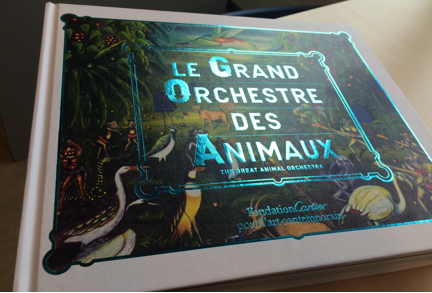
Work by the Sea Around Us was recently used for the book Le Grand Orchestre Des Animaux, a visually stunning oeuvre described as an “aesthetic, scientific, and philosophical” exploration of the animal world, and a book that also describes the innovative work of Bernie Krause, an American musician and ecologist who dedicated his life to the collection of natural soundscapes. Continue reading
Video: Dr. Dyhia Belhabib concludes West African capacity-building workshop
After two weeks of work and lectures the West Africa capacity-building workshop is coming to a close.
Organized by Dr. Dyhia Belhabib and funded through the MAVA Foundation, researchers from West African countries collaborated on many fisheries issues important to the sub-region.
Watch this 5 minute video to better understand what the workshop was about, and who was involved.
Under-reporting of Fisheries Catches Threatens Caribbean Marine Life

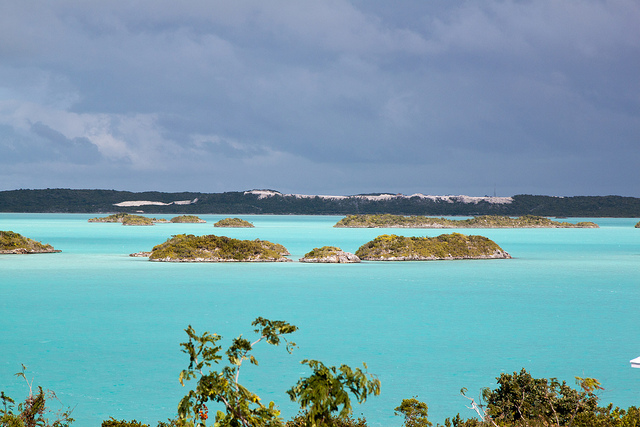
Turks and Caicos. Credit: Tim Sackton.
A recent study published in the open-access journal Frontiers in Marine Science reveals that marine fisheries catches have been drastically under-reported in the Turks and Caicos Islands in the Caribbean, threatening the marine environment and livelihoods of the local community. Lead researcher Aylin Ulman recently based at the Sea Around Us (Institute for the Oceans and Fisheries) in Vancouver, and her team call for urgent action from policy-makers to ensure the future sustainability of the fishing industry in this archipelago nation.
Fishing has historically been the main industry in the Turks and Caicos Islands, although tourism is now taking the lead. A higher demand for locally caught seafood is placing increasing pressure on local marine life. The islands operate small-scale fisheries for queen conch, Caribbean spiny lobster, and finfish as the three main target taxa groups. The local government is required to report all catches to the Food and Agricultural Organization (FAO), as all UN member countries are voluntarily bound to complete each year. However, the data that are passed on by Turks and Caicos to the FAO are incorrect because they account only for commercial catches destined for export, omitting all catches caught and consumed by locals and tourists on the islands. “DEMA has done a great job of monitoring fish sold to the country’s fish plants,” said Aylin Ulman. “However, it seems they have not always had enough staff to monitor seafood being sold or given to locals and tourists, whether that be at the dock, in shops, or in restaurants.”
To be able to trade with signatory nations of CITES, the Convention on International Trade in Endangered Species of Wild Fauna and Flora, it must be demonstrated that the international trade of wild animals and plants does not threaten the stocks local survival. The data illustrated from this report clearly demonstrate that the conch export quota is unsustainable and should be drastically reduced to protect local conch stocks from overexploitation. The derivation of the ‘so called’ maximum sustainable yield quota incorporates catches only destined for export, but sometimes factors in local consumption estimates which have been vastly underestimated, putting the future of the stocks at risk. For a better estimate of the amount of seafood caught around the islands, and hence total reconstructed catches for the island nation, the authors assessed all catches between 1950 and 2012. More accurate records of catches for export, artisanal, and subsistence fisheries were identified from Turks and Caicos Islands Government reports. In addition, a recent and thorough seafood consumption study completed in 2013 involving locals and tourists enabled more accurate estimates of the previously unreported local consumption amounts. The reconstructed data also includes estimates of recreational catches and illegal poaching.
Using recently developed mathematical models and newly collected data, Ulman’s research team have been able to project the most accurate estimates to-date of fish consumption by TCI residents and tourists. The results showed that the actual catches were an alarming 2.8 times higher than that reported to the FAO, and 86% higher after her team had adjusted the reported data using expert analysis, and this has very troubling implications. Reported catches have been used to put regulations in place for sustainable catch limits. However, these limits have been unsustainable, leading to the overexploitation of marine life. In fact, local consumption of conch is close to the total number allowed to be caught under these ‘sustainable’ limits, and this is without taking into account the number of conch that are exported, which almost equate to local consumption. As a result of this study, the authors hope that in the future catch limits will be based on total seafood catches from all fishery sectors. Local seafood consumption surveys should continue to be completed once each 3-5 years to track changing patterns, especially with the ongoing growth of tourism. These considerable local consumption catch amounts must be factored into the equation when calculating the total allowable catch limits, especially for the key species of conch and lobster to determine if it is even possible to continue the export business.
New legislation is needed to reduce seafood catches so the stocks are being fished within safe limits, and this study adds new weight to the urgency of this issue. The Turks and Caicos Islands Government have recommended a stop to the export of conch for up to five years to allow populations to recover, but they have been delayed in implementing this. While the results of the research may seem like bad news, the researchers are quick to emphasize that the new data may actually present an opportunity. Edward Hind added, “The staff at DEMA now have the knowledge to set catch limits that really will work. If the government supports the TCI’s fisheries scientists in collecting better catch data going forward, then the country can have healthy fisheries for decades to come.”
The under-reporting of fisheries catches is common in other regions and neighbouring island nations. Haiti, the Dominican Republic, and Jamaica are facing the same the problems and urgent action is required to avoid further overexploitation of marine life.
Read the full article by Aylin Ulman, Lily Burke, Edward Hind, Robin Ramdeen and Dirk Zeller: ‘Conched Out: Total Reconstructed Fisheries Catches for the Turks and Caicos Islands Uncover Unsustainable Resource Usage’ in Frontiers in Marine Science.

Longtime Sea Around Us member Kyrstn Zylich embarks on new career

Kyrstn Zylich is set to begin her studies in occupational therapy at the University of Alberta this September.
Kyrstn Zylich — for many years a key pillar of the Sea Around Us team — will soon be departing for the frozen tundra of Edmonton in pursuit of an advanced degree in occupational therapy at the University of Alberta.
A senior research assistant with the project over the past four years, Kyrstn has been instrumental in coordinating and finalizing countless catch-reconstruction reports and datasets, many in collaboration with colleagues across the globe.
She started with the project as a volunteer in 2011, and soon after transitioned to a full-time research assistant opportunity. In 2012 she made the jump to senior research assistant and has since proven herself a highly organized, collaborative and thoroughly positive member of the team.
For Kyrstn, what made her time at the Sea Around Us especially memorable were the colleagues she worked with.
“A big part of why I enjoyed the job was that I loved the people here, and I’ve made so many incredible friendships,” she said.
It was a class she took as an undergrad called “Darwin’s Fishes” — taught by Daniel Pauly — that really sparked her interest in marine sciences. “We read sections of the Origin of Species and discussed different concepts within; we talked about natural history, and shifting baselines,” she said.
When Kyrstn took over the job as senior research assistant in 2012 she was thrust into a demanding role. But she took to the challenge like a fish in water and thrived in the new position.
“I was able to communicate with people from all over the world, answering their questions about catch-reconstructions, editing reports and training people, among a variety of other duties,” she said.
She is now off to tackle a new challenge. Her affinity for science has led her to occupational therapy, where she wants to learn hands-on skills to help children with cognitive injuries better participate in school; and aid the elderly so they can stay independent; or help those with injuries transition back to work.
She has a month before her masters program starts in September.
“I’m very sad to be leaving the West Coast, it’s so beautiful here. But I’m excited to explore a new city and have a change of scenery,” she said.
However, the bigger issue for Kyrstn is sports. Kyrstn is a die-hard Vancouver Canucks fan and her office is draped with images of hockey players like Alex Burrows and, the ‘anointed one’, Trevor Linden. When asked whether she will change her allegiance to the Edmonton Oilers she doesn’t hesitate: “Never.”
As the sports-bars fill up with rowdy Oilers fans in Edmonton, Kyrstn acknowledges she may have to “silently support” her hometown team.
The Sea Around Us wants to thank Kyrstn for her tremendous contribution to the project, and wishes her success in her future endeavours!
Collaborative Research
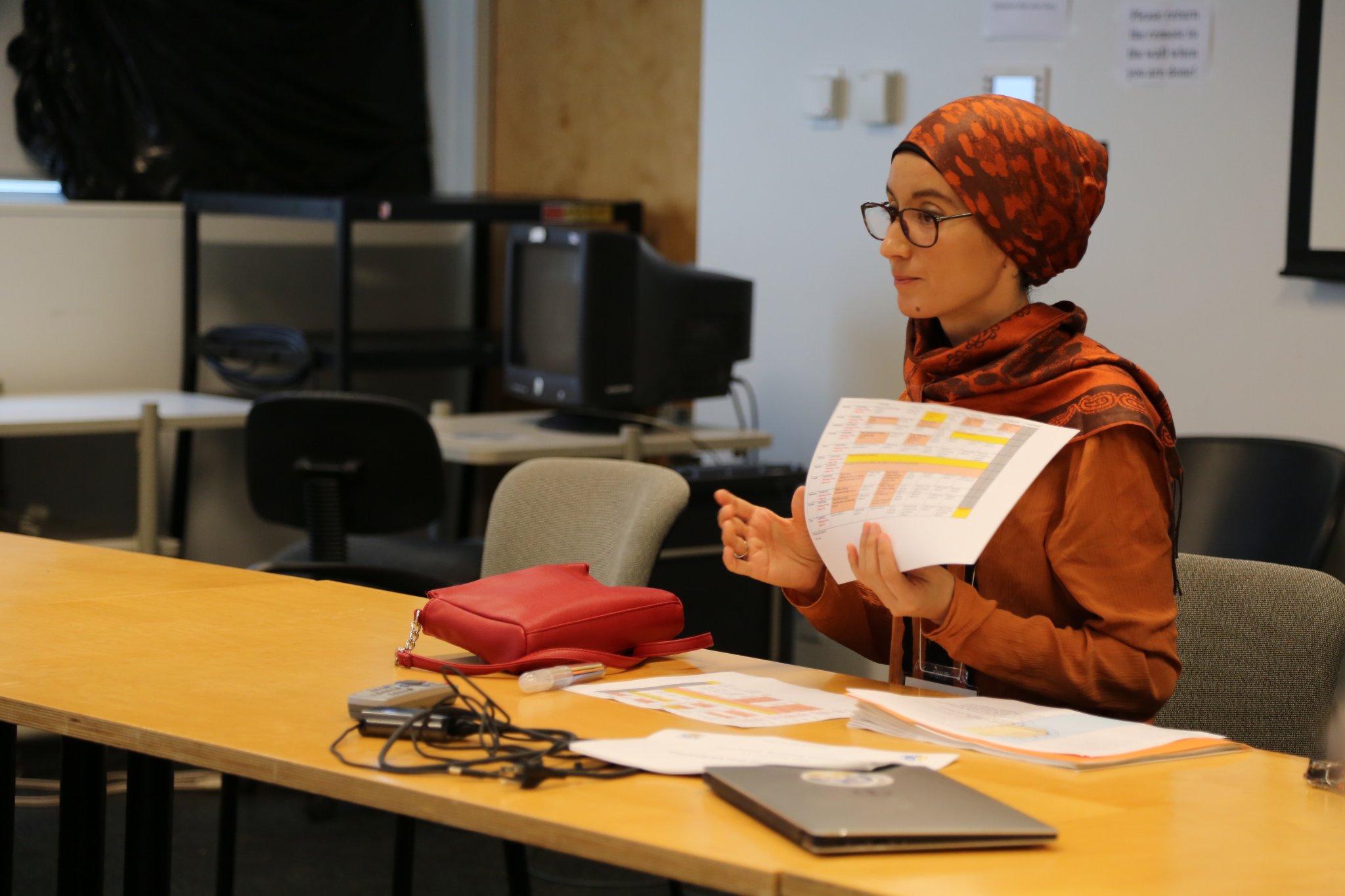
On the third day of the West Africa capacity-building workshop researchers narrowed down subject areas to analyze — areas, they agree, that are affecting all countries in the West Africa sub-region, and therefore, need to be confronted through nation-to-nation collaboration.
Dr. Dyhia Belhabib, who organized and is coordinating the two-week workshop, said that four topics have been decided upon. These are, broadly, climate change, marine protected areas, illegal fishing, and governance. A different group of researchers will look at each of the topics.
For climate change, it is important to understand the resilience of artisanal fisheries in the facing of changing temperatures, and mitigation steps that can be taken. Regarding marine protected areas (MPA’s), the researchers will look at tools for assessing and evaluating their effectiveness, and how MPA’s create resilience in local communities. A group of researchers will study whether enforcement is an effective measure to recover value lost by IUU fishing. And finally, another group will study the need for better data in facilitating effective governance.
The workshop is a unique opportunity for researchers from multiple West African countries to share data and experience.
Alkaly Doumbouya, a Senior Scientist at Guinea’s centre for fisheries science, believes finding data to combat these issues is difficult — yet meeting with researchers from other countries, and with the Sea Around Us, can help fill in the gaps.
“It is not easy to find data because data is rarely made public. And the ministries do not work well together,” he says about Guinea, where he is from.
To help with this issue, other members in the workshop are helping to find relevant data, he adds.
Dyhia, who is facilitating the dialogue among the various groups, is emphasizing the sharing and collaboration of information. “Every group is contributing to other groups” she says.
Doumbouya believes Dyhia is essential to the workshops functioning. “Dyhia has travelled to all these countries and understands the issues there,” he says.
Doumbouya’s group in the workshop is looking at illegal fishing. He says there is a lot of data on the number of illegal boats caught, and how much fish they have caught, as well as the fines they have paid — yet the problem is that all the data is spread through various institutions in his country, Guinea. He hopes that countries in the sub-region can come together, share data, and create standardized rules to measure the effects of illegal fishing, and enforce rules prohibiting it.
The workshop will break after lunch for a trip to the Vancouver Aquarium. Updates to come.