

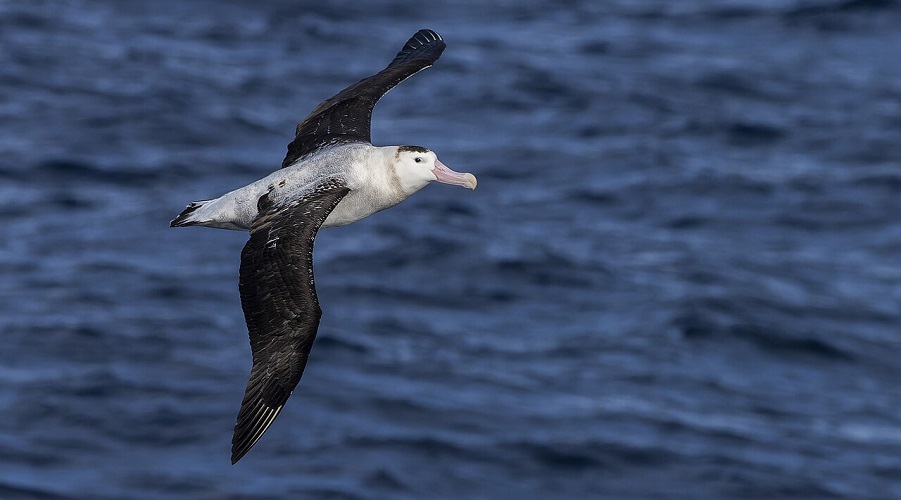
Endemic Antipodean albatross. Photo by Oscar Thomas, Wikimedia Commons.
World Oceans Day (WOD), the initiative proposed in 1992 by Canada at the Earth Summit in Rio de Janeiro and officially recognized by the UN in 2008, aims to catalyze collective action for a healthy ocean and a stable climate.
Some of the yearly campaigns thousands of organizations run, inspired by this goal, are guided by the annual action theme that NGO The Ocean Project proposes for WOD. The Ocean Project, together with the World Ocean Network, led efforts to get the UN to recognize June 8th as World Oceans Day.
For 2026, the action theme is “Strong Marine Protected Areas for our blue planet,” which is meant to build on the momentum of recent agreements, such as the 2022 Kunming-Montreal Global Biodiversity Framework and the High Seas Treaty ratified in 2025, and push for stronger ocean conservation actions.
To support this endeavour, every month from January to June 2026, the Sea Around Us will take a deep dive into one MPA in its database and use this blogging space to share, in lay language, what factors make it a successful or unsuccessful MPA.
Moutere Mahue / Antipodes Island Marine Reserve
In April, we are taking a look at the Moutere Mahue / Antipodes Island Marine Reserve, a 2,173-square-kilometre fully no-take area. It is part of the New Zealand Sub-Antarctic Islands UNESCO heritage site, which lies between the Antarctic and Subtropical Convergences.
The reserve itself surrounds the Antipodes Islands, a group of volcanic cones and vents 750 kilometres south of New Zealand’s South Island and Stewart Island/Rakiura. It was established in 2014 and, by law, only diving and anchoring are allowed, as long as there is no damage to the reserve, and they don’t take place in areas closed for research purposes.
All fishing, on the other hand, is forbidden there, with multi-agency patrols conducted by the New Zealand Defence Force and analyses of commercial fishing vessel information from statutory returns and satellite vessel monitoring by Fisheries New Zealand.
Sea Around Us research found that, indeed, little to no fishing takes place in the area, which has been the case for decades. “Analyses of historical fishing effort indicated that there had been very limited commercial fishing recorded in the territorial sea around Antipodes Island and no recreational or customary fishing,” government information states.
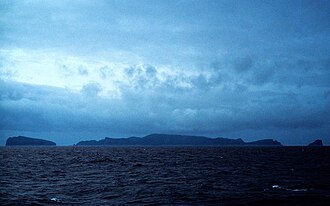
Antipodes Island. Photo by Benjamin Hell, Wikimedia Commons.
The absence of fishing activities makes sense as the Antipodes Island is the most remote of New Zealand’s subantarctic islands. Since it lies on the eastern edge of the Bounty Plateau, it features an area of shallower sea (600-1000 metres) amidst the Southern Ocean, where depths average 4000-5000 metres.
According to the NZ Department of Conservation, underwater, extensive rock walls are covered in bright pink layers of encrusting seaweeds, where a range of animals, such as sponges, anemones, and bryozoans, live.
Bull kelp also forms forests down to over 20 metres depth, but there are more than a hundred described seaweeds and, authorities believe, almost certainly many more, as research has been scarce in this hard-to-access place.
Nearshore species such as Antarctic cod are present, as well as offshore species such as lingcod and Patagonian toothfish.
On land, the endemic Antipodean albatross has established its main breeding ground (about 5,000 breeding pairs), while large colonies of eastern rockhopper and erect-crested penguins also exist there, although the Department of Conservation has reported that the latter’s population has declined substantially in the past 20 years, for unknown reasons.
According to the International Union for Conservation of Nature, many of the threats impacting penguins and other animals at the site occur outside of it, and are beyond the control of the management agency, for example, climate change and commercial fishing bycatch.
The organization points out that pathogens such as those causing avian influenza could potentially reach the island and devastate seabird and marine mammal populations.
“Ongoing strict biosecurity, removal of the remaining introduced species and continued controls on access and permissible activities are seen as top priorities for the protection of the site,” the IUCN notes. “Ongoing marine mammal and seabird research is also necessary for informing bycatch mitigation initiatives at national and international scales. If current management controls are kept in place, then the level of threats and their impacts are likely to remain low.”
- January MPA: French Southern and Antarctic Lands
- February MPA: Tubbataha Reefs Natural Park
- March MPA: Los Roques National Park