
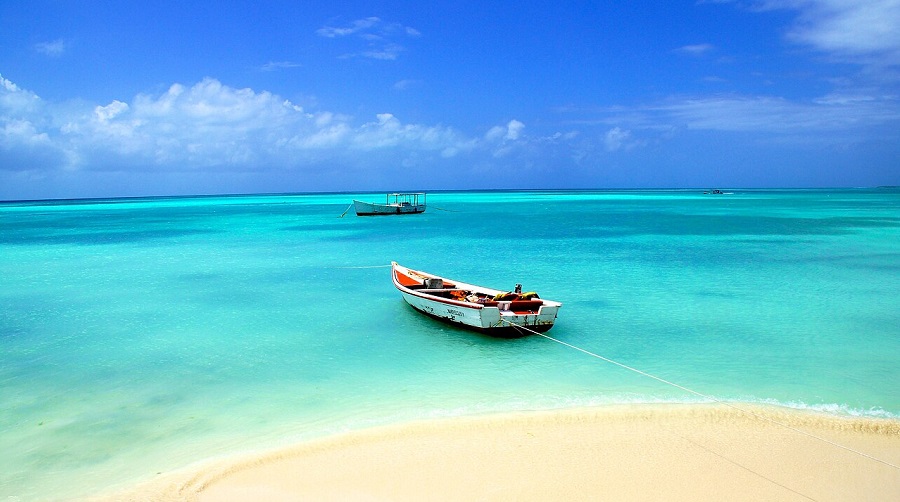
Los Roques National Park in Venezuela. Photo by Tucanrecords, Wikimedia Commons.
World Oceans Day (WOD), the initiative proposed in 1992 by Canada at the Earth Summit in Rio de Janeiro and officially recognized by the UN in 2008, aims to catalyze collective action for a healthy ocean and a stable climate.
Some of the yearly campaigns thousands of organizations run, inspired by this goal, are guided by the annual action theme that NGO The Ocean Project proposes for WOD. The Ocean Project, together with the World Ocean Network, led efforts to get the UN to recognize June 8th as World Oceans Day.
For 2026, the action theme is “Strong Marine Protected Areas for our blue planet,” which is meant to build on the momentum of recent agreements, such as the 2022 Kunming-Montreal Global Biodiversity Framework and the High Seas Treaty ratified in 2025, and push for stronger ocean conservation actions.
To support this endeavour, every month from January to June 2026, the Sea Around Us will take a deep dive into one MPA in its database and use this blogging space to share, in lay language, what factors make it a successful or unsuccessful MPA.
Los Roques National Park
In March, we are taking a look at the Los Roques Archipelago National Park in Venezuela, as it tops the Sea Around Us’ Paper Park Index, which identified marine protected areas where enough fishing takes place to contravene the protection status officially assigned to such sites.
This park, located in the Caribbean Sea north of mainland Venezuela, consists of approximately 350 islands, cays and inlets occupying 1,646 square kilometres and hosting extensive coral reefs, seagrass beds, mangroves and shallow macroalgae meadows.
Although spearfishing has been prohibited since 1972 and fishing with nets was banned in 1992, there are reports of an important lobster fishery in the area, with underreported catches taken from the restricted zones, including the poaching of sea turtles, a recreational fishery of bonefish (Albula vulpes) and heavy exploitation of West Indian topshell (Cittarium pica) and queen conch (Strombus gigas), even though the fishery for the latter is supposed to have been closed since 1991.
“Lack of staff and funding has meant that illegal fishing and overfishing have always been a serious problem. When the lobster season is closed from February through September, queen conch poaching intensifies,” the Smithsonian Institution’s Atoll Research Bulletin No. 622, published in 2019, states. “In general, management implementation in Los Roques appears weak and vulnerable.”
This situation has not improved ever since, as the country’s economic collapse has created shortcomings in the work of government institutions responsible for law enforcement and fisheries management.
According to a 2022 Oceana report using Global Fishing Watch (GFW) data, from 2017 to 2020, three Venezuela-flagged fishing vessels appeared to spend 30 hours fishing in Los Roques. Two of the three vessels were tuna purse seiners, and the other was a pole-and-line vessel.

Lobster fishers in Los Roques. Photo by Márcio Cabral de Moura, Flickr.
GFW data also showed that fishing within the Los Roques MPA peaked in 2020, with some local fishing boats turning off their automatic identification systems.
Despite Los Roques having seven management zones, four of which are closed to recreational and commercial fishing, transportation, and tourism, enforcement is challenging.
“Current conservation efforts in Venezuela are deficient, given the collapse of government institutions responsible for the management of fisheries. This has led [for example] to noncompliance with fishing regulations designed for elasmobranchs,” a 2021 paper by Marquez et al., published in the journal Ciencias Marinas, reads.
In Los Roques, the main targeted shark species are blacktip shark (Carcharhinus limbatus), Caribbean reef shark (Carcharhinus perezi), silky shark (Carcharhinus falciformis), nurse shark (Ginglymostoma cirratum), and lemon shark (Negaprion brevirostris). The latter are known to give birth within the park, which serves as a nursery habitat for juveniles.
Another 18 shark species can be seen in the area, as well as 284 fish species, 77 sponge species, 45 echinoderm species, 140 mollusk species, 200 crustacean species and 69 coral species, data from InternationalParks.org show.
The lack of enforcement of conservation measures is also affected by the repurposing of financial resources to populist activities. In an interview with Mongabay, the president of Venezuela’s Shark Research Center, Rafael Tavares, said that the Ministry for Fishing and Aquaculture tends to concentrate both its human and capital resources on an annual “Fish Fest,” instead of designing measures or public policies to ensure the conservation of threatened marine species.
“Unfortunately, Los Roques seems to be a paper park,” said the Sea Around Us principal investigator, Dr. Daniel Pauly. “Active enforcement, maybe guided by NGOs, is needed to make sure that the four areas where fishing is forbidden really become no-take marine reserves where fish can find a respite and reproduce, and where abundance can be rebuilt. If this is effectively implemented, over time, there is likely to be spillover to nearby areas where fishing is allowed.”
- January MPA: French Southern and Antarctic Lands
- February MPA: Tubbataha Reefs Natural Park