

 This week, several members of the Sea Around Us Project head off to the 2010 meeting of the American Association of the Advancement of Science (AAAS) in San Diego, California. On Saturday, Daniel Pauly is a speaker on the panel Denial, Detente, and Decisions: Fisheries Science at the Crossroads. Also that day, Villy Christensen has co-organized a panel titled Bridging Science and Society for Sustainability: The Role of Visualization, where Sherman Lai will be speaking. Jennifer Jacquet has organized and will speak on the panel Preserving the Global Commons Through Conservation and Cooperation on Sunday. We look forward to reporting back on the results of this big event.
Category: New & Notable
MEY=MSY
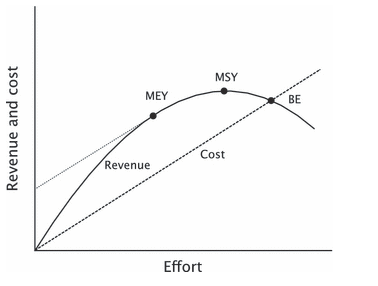 When one considers all the extra value generated in a fishery such as processing, distribution and marketing of fish products, higher fisheries quotas make more sense, according to a new paper titled MEY=MSY by Villy Christensen published in Fish and Fisheries. For more than 50 years, it has been generally accepted that the fishing sector stood to gain from managing fisheries at the effort level producing maximum economic yield (MEY) rather than maximum sustainable yield (MSY), which occurs at a higher effort level. “If operating at the lower MEY level would result in so much higher profit to the individual boats and to the fishing sector while maintaining catches nearly at MSY why don’t they?” asks Christensen in the paper. He explains that MEY was built on the assumption that only the revenue and cost structure for the fishing fleet were considered. Christensen points out that when processing, distribution and marketing of fish products are taken into account, there are more profits to be gained, which in turn makes MSY — and a higher fishing effort — the more appropriate target for fisheries.
July/August 2009 Newsletter
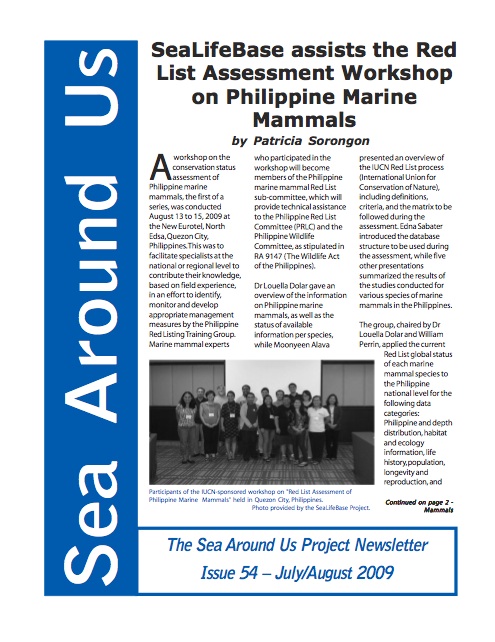 Read about new applications using SeaLifeBase and FishBase among other things in the latest Sea Around Us newsletter here.
UNEP video features Rashid Sumaila
High Seas Fleet Kept Afloat with Subsidies
 High seas bottom trawlers catch some of the tastiest fish (think Orange roughy, rockfish, and Patagonian toothfish), which are also some of the most vulnerable and overfished species because they grow and mature so slowly. A new study shows that this type of overfishing continues because the 200-strong trawling fleet is kept afloat with government money.
Several members of the Sea Around Us Project led by fisheries economist Rashid Sumaila estimated bottom trawl fleets operating in the high seas, i.e., outside of the Exclusive Economic Zones of maritime countries, receive an estimated US$152 million per year in fisheries subsides, which is 25% of the total landed value of the fish. The profit achieved by this vessel group is normally not more than 10% of landed value, which means that without subsidies, the bulk of the world’s bottom trawl fleet operating in the high seas will be operating at a loss, and unable to fish, thereby reducing the current threat to deep-sea and high seas fish stocks. The study is titled Subsidies to high seas bottom trawl fleets and the sustainability of deep-sea demersal fish stocks and was published online this month in the journal Marine Policy.