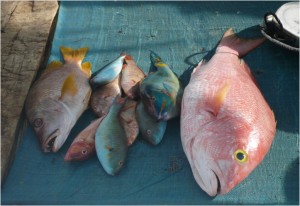
 This is an article by Sea Around Us researcher Stephanie Lingard, and also appeared in the September/October newsletter.
Jamaica, the land of wood and water, famous for its warm people, reggae music, jerk chicken and overfished reefs. Jamaica lives up to its reputation in every aspect. The people are some of the kindest, warmest and funniest you could hope to meet in your life. The landscape is an impossibly beautiful green, the food is flavourful, and… the reefs are desolate. However, there are many reasons to expect a better future for Jamaica’s fishers and fishes.
During the winter of 2010 and spring of 2011 I was given the opportunity to live in Jamaica on an internship funded by the Canadian International Development Agency (CIDA). Having worked at the Fisheries Centre for the summer of 2010, I was delighted to find I would be working alongside the Fisheries Division of Jamaica’s Ministry of Fisheries and Agriculture. I was working with an initiative called Improving Jamaica’s Agricultural Productivity Project (IJAPP). The fisheries aspect of the project, funded in part by CIDA, had three focus points: market facilities, enhancement of fisheries resources through artificial reefs, and capacity building with fishers in six south coast fishing villages. The project also worked to establish co-management bodies within each of the fishing villages. These bodies would be responsible for managing the new markets, and community organization tasks. Capacity building included workshops concerning all aspects of life: money management, conflict resolution, ecological knowledge, fisheries management, and safety at sea, to name a few. During the workshops, fishers faces lit up, and they absorbed the information eagerly. Community members were deeply thankful to have the opportunity to learn how they could care for their resources and improve their livelihoods. Working with fishers during workshops was by far the most rewarding aspect of my time there, and I’m happy to report: progress is being made.
A long list of challenges is faced by the ecosystems of Jamaica: invasive lionfish, pollution, overfishing, destructive fishing habits, lack of regulation, hurricanes, and coral disease. Initially, working among these challenges made it difficult to stay positive and understand why we were building fish markets while previously donated gear sheds, from the European Union, sat unused. Why were new reefs, sure to be targeted by destructive fishing practices, being built? In my mind, enforcement of fish sanctuaries (MPAs), and other regulations were clearly a priority. I often asked myself what the solution was to the myriad of problems, often feeling like I had nothing to offer the fishers or the fish.
Then, as time went on, my attitude changed. The more I became involved with the fishing community, and after meeting fishers and fisheries officers, I felt things, like my attitude, could be changed. The fishers themselves provided inspiration. Despite hauling up empty pots (Antillean Z traps) day after day, they continued to smile and laugh. At community meetings hosted by the project, many fishers were outspoken with other community members about the need to stop dynamite fishing, and other destructive practices. Many fishers I spoke with also expressed that, while they may not see the benefits of their changed behaviour, it was important to keep working at it for the next generation of fishers. The fisheries division staff, Dr. Karl Aiken (the Jamaican fish expert with the University of the West Indies), and members of local NGOs provided constant inspiration as well. All of these dedicated people have worked for years amongst funding cuts, broken government promises, destructive fishers, and natural disasters, and yet they persist in good spirits.
My friend Nakhle Hado, who works with Food for the Poor, teaches lionfish handling workshops around the island. He works tirelessly with fishers to teach them less destructive fishing techniques (like deep water handlining vs. trap fishing), as well as encouraging them to catch lionfish. Along side this work, he promotes a market for lionfish by selling it on the menu of his family’s restaurant in Kingston. The fried lionfish is amazing! The trend appears to be catching on as I had several fishers tell me they prefer lionfish to other types of fish, and that they have customers who will come to them specifically for the prickly fish. In time, it may just become a Jamaican delicacy.
The Nature Conservancy is currently working with the Fisheries Division to set up enforcement of the Pedro Bank Fish Sanctuary. Pedro Banks is a large fishing ground with several small sandy cays which host a transient community of fishers approximately 60 km off the south coast of Jamaica. Although funding is slow to come through, all are hopeful this will commence before the end of this year, or in early 2012.
The Oracabessa Fish Sanctuary was finally launched on October 9, 2011, Dr. Aiken giving me the good news. There is a wonderfully dedicated group of local NGOs working to get the rest of the 8 designated fish sanctuaries off the ground: Caribbean Coastal Areas Management Foundation, Blue Fields Bay Fishermen’s Friendly Society, St. Mary Fishermen’s Cooperative, Oracabessa Foundation, The Negril Coral Reef Preservation Society, The Montego Bay Marine Park Trust, Fisheries Division, Alloah fisher group and Business Community.
Despite several decades of hardships, and slow-moving political action, there is a strong community of fish-friendly organizations and individuals in Jamaica. I hope the return of the herbivorous long-spined sea-urchin (Diadema antillarum), combined with the much anticipated launch of the fish sanctuaries, and a burgeoning lionfish market signal a recovery of Jamaica’s marine resources.


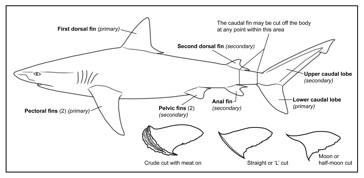 Shark fins are worth more than other parts of the shark and are often removed from the body, which gets thrown back into the sea. To curtail this wasteful practice, many countries allow the fins to be landed detached from shark bodies, as long as their weight does not exceed five per cent of the total shark catch. New University of British Columbia research shows that this kind of legislation is too liberal.