 Leah Biery, M.Sc. student with the Sea Around Us Project, asks this question in the most recent newsletter. Her article is also reprinted here.
When you dine out, how do you decide what to order? Do you head to the restaurant with a clear idea of what you want to eat, or are you influenced by the daily specials and suggestions from your server? While living in Southwest Florida, where the tourism-based economy revolves largely around seafood restaurants, I became interested in how vacationers decide which seafood items to consume. I frequently overheard people announce that they were going out for grouper (or oysters or snapper…), apparently already certain of what they would order before even sitting down at a table. Others seemed less sure about what they would eat, but knew that after a long day at the beach, they were in the mood for some kind of seafood. Around the time I made these observations, I was working on a local sustainable seafood initiative, so I wondered if and how those who sat down in a restaurant without a specific dish in mind could be influenced to choose a sustainable option.
After considering the many factors that influence customer choices in a restaurant, I decided to look at server suggestions and daily specials, two elements of the dining experience that often influence my own menu decisions. I recruited two high school students associated with the organization I was working for to help me design and distribute a survey for tourists on Sanibel Island. What follows is a summary of what we learned.
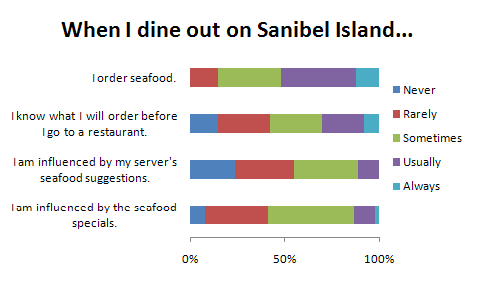
Of the tourists surveyed, 52% usually or always order seafood when they dine out on Sanibel Island. An additional 33% sometimes order seafood. This indicates that the local demand for seafood is high, so even a small increase in the proportion of people who make sustainable choices could contribute to the recovery of popular, rapidly declining species like grouper and queen conch (in 2008, queen conch and five grouper species were listed as overfished or subject to overfishing in the Southeast region of the U.S.*).
We found that 43% of tourists surveyed rarely or never knew which seafood they were going to order before dining at a restaurant. These consumers have not made a decision before sitting down, so some of them would likely be receptive to seafood recommendations from restaurant staff. On this note, 45% of tourists surveyed responded that they were sometimes or usually influenced by server suggestions. Furthermore, 45.5% responded that they were sometimes influenced by the seafood specials. An additional 14% were usually or always influenced by the seafood specials.
Eating seafood near the ocean is undoubtedly an essential part of the beach vacation experience, but for many people, the specific type of seafood may not really matter. Our results indicate that server suggestions and daily specials could potentially be used as effective tools for influencing diners to make sustainable choices. As a means of boosting sustainable seafood sales and reducing the demand for red list species, sustainability initiatives could educate local restaurant management about sustainable seafood and encourage them to advertise only sustainable options as daily specials. Additionally, servers could be trained to routinely suggest sustainable options to customers. This would only work with sufficient interest and participation from dining establishments. Although our findings are specific to Sanibel Island, a similar approach might be effective in other locations as well.
While working to promote sustainable seafood in a tourist town, it became apparent to me that most vacationers want to relax and not obsess over sustainability. First and foremost, consumers want their meals to be tasty, so I am not implying that restaurants should recommend certain items solely on the basis that they are sustainable. Restaurants interested in operating sustainably could take a backstage approach by purposely selecting and buying sustainable items for special recommendation, but presenting them to customers as they would any suggestion – delicious. Sustainability should be mentioned as an additional perk, but not forced upon patrons as the only reason to choose the special. If a proportion of diners will order the special whether it is sustainable or not, it makes sense that restaurants concerned about the future of fish should always offer a suggestion or special that is.
These ideas are just small steps on the path to recovery for depleted fish stocks, but it is apparent that seafood restaurants hold important influential power when it comes to which menu items they recommend to patrons. Especially in areas frequented by tourists who are often on vacation from the stress of thinking about sustainability, dining establishments should take more responsibility for protecting the future of ocean resources. Restaurants with good foresight should be willing to use their power to reduce pressure on overfished species so that eating seafood can remain an essential part of beach vacations for generations to come.
Thank you to Sanibel Sea School and Lena and Natalia Horvath for their help with survey design and data collection.
Endnotes
*NMFS, 2009, Annual Report to Congress on the Status of U.S. Fisheries-2008, U.S. Department of Commerce, NOAA, Natl., Mar. Fish. Serv.,Silver Spring, MD, 23 pp.


 Read about potential economies of scale in marine protection in this piece at Nature, which highlights work by Sea Around Us Project members Ashley McCrea Strub and Daniel Pauly that they presented at IMCC in May.