
 This week, several members of the Sea Around Us Project head off to the 2010 meeting of the American Association of the Advancement of Science (AAAS) in San Diego, California. On Saturday, Daniel Pauly is a speaker on the panel Denial, Detente, and Decisions: Fisheries Science at the Crossroads. Also that day, Villy Christensen has co-organized a panel titled Bridging Science and Society for Sustainability: The Role of Visualization, where Sherman Lai will be speaking. Jennifer Jacquet has organized and will speak on the panel Preserving the Global Commons Through Conservation and Cooperation on Sunday. We look forward to reporting back on the results of this big event.
Daniel Pauly Delivers Keynote at Seafood Summit
 Daniel Pauly recently gave the keynote address at the 2010 Seafood Summit in Paris. His talk compared industrial fishing to a Ponzi scheme, where instead of extracting a sustainable interest from invested capital, we use up the capital itself, and hope for other ‘investors’. He discussed the three-way expansion of fishing through the 20th century: geographically, by fishing in distant waters and getting access to African, Caribbean and Pacific waters; by fishing in deeper and deeper waters; and a taxonomic expansion. Pauly then addressed aquaculture and its limitations, particularly the double accounting of carnivorous farmed fish. He finished by talking about conservation efforts and the need to include the small-scale fisheries in the developing world in conservation efforts. His full talk is available through the Seafood Summit website.
MEY=MSY
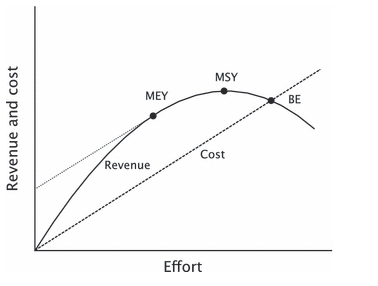 When one considers all the extra value generated in a fishery such as processing, distribution and marketing of fish products, higher fisheries quotas make more sense, according to a new paper titled MEY=MSY by Villy Christensen published in Fish and Fisheries. For more than 50 years, it has been generally accepted that the fishing sector stood to gain from managing fisheries at the effort level producing maximum economic yield (MEY) rather than maximum sustainable yield (MSY), which occurs at a higher effort level. “If operating at the lower MEY level would result in so much higher profit to the individual boats and to the fishing sector while maintaining catches nearly at MSY why don’t they?” asks Christensen in the paper. He explains that MEY was built on the assumption that only the revenue and cost structure for the fishing fleet were considered. Christensen points out that when processing, distribution and marketing of fish products are taken into account, there are more profits to be gained, which in turn makes MSY — and a higher fishing effort — the more appropriate target for fisheries.
UBC End of the Line Screening with Pauly & Sumaila
 UBC will host a screening of The End of the Line on Wednesday, January 13th from 4:00 pm – 7:00 pm in the Multipurpose Room at the Liu Institute for Global Issues. Please join us for a film screening and discussion, featuring the Sea Around Us Project’s Daniel Pauly and Rashid Sumaila. Register for the event here. Co-hosted by UBC’s Liu Institute for Global Issues and Fisheries Centre.